Welcome to Code Forum!

Join a community that supports you and your coding journey from day one. We strive to be a friendly, supportive community that empowers everyone to be better developers. By registering with us, you'll be able to discuss, share and private message with other members of our community.

SignUp Now!
  • Guest, before posting your code please take these rules into consideration:
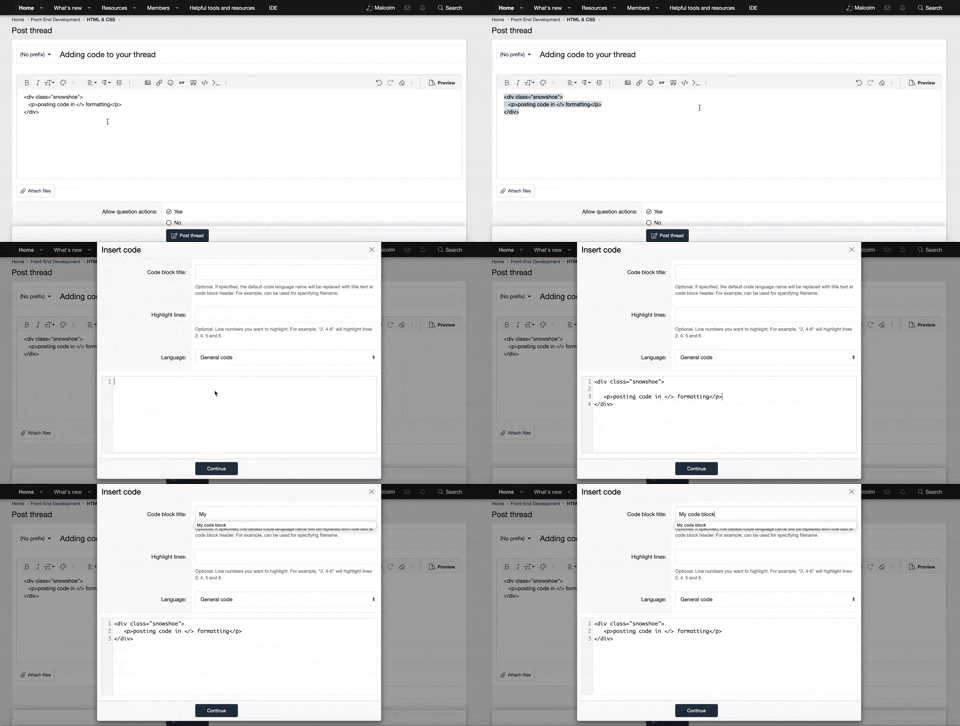
    • It is required to use our BBCode feature to display your code. While within the editor click < / > or >_ and place your code within the BB Code prompt. This helps others with finding a solution by making it easier to read and easier to copy.
    • You can also use markdown to share your code. When using markdown your code will be automatically converted to BBCode. For help with markdown check out the markdown guide.
    • Don't share a wall of code. All we want is the problem area, the code related to your issue.

    GIF shows where to locate </> in the thread and or post editor toolbar.
    To learn more about how to use our BBCode feature, review our "How to post your code into threads" here.

    Thank you, Code Forum.

incorrect symbols in terminal

kancler

New Coder
Hello, guys! Can you help me with a problem, please?
I use C on Ubuntu.
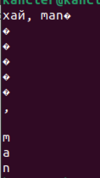
When I try to print a single Cyrillic symbol with '\n' (or any other symbol) at the end I get '?' in terminal, with ASCII symbols all is right.
Screenshot from 2022-04-16 12-32-55.png
C:
char buff[255] = "хай, man";

    for (int i=0; i<(strlen(buff)); i++) {
         printf("%c\n", buff[i]);
     }
If I print Cyrillic symbols in a raw (without '\n') - I get ? only at the end of the string.
 
Last edited:
Solution
Yes ! I've seen and know about this stuff, but I've never programmed it myself. So I can't give you a ready solution, sorry. If you get it to work do let us know !
Helped me solve this issue and I figured out a little how to work with unicode.

C:
#include <ctype.h>
#include <stdlib.h>
#include <stdio.h>

int main(void) {
  char buff[255] = u8"хай, man";
  size_t len = strlen(buff);

  for (size_t i = 0; i<len; i++) {
    char ch = buff[i];
    // If ASCII character ....
    if ((ch & 0x80) == 0) { 
      printf("%c\n", ch);
    } else {
      // Process UTF-8
      char b[5] = { ch };
      size_t j;
      for (j = 1; (j < 4) && ((buff[i+j] & 0xC0) == 0x80); j++) {
        b[j] = buff[i+j];
      }
      b[j] = 0...
Your C compiler probably uses UTF8 for character encoding. This means that ASCII characters are one byte and Cyrillic characters are two bytes. So you can't loop through them as if they were all one byte ! You'll need to read up on handling Unicode characters. It's not an easy subject.
 
Your C compiler probably uses UTF8 for character encoding. This means that ASCII characters are one byte and Cyrillic characters are two bytes. So you can't loop through them as if they were all one byte ! You'll need to read up on handling Unicode characters. It's not an easy subject.
Thank you! Now it is clear where is problem.
 
Yes ! I've seen and know about this stuff, but I've never programmed it myself. So I can't give you a ready solution, sorry. If you get it to work do let us know !
Helped me solve this issue and I figured out a little how to work with unicode.

C:
#include <ctype.h>
#include <stdlib.h>
#include <stdio.h>

int main(void) {
  char buff[255] = u8"хай, man";
  size_t len = strlen(buff);

  for (size_t i = 0; i<len; i++) {
    char ch = buff[i];
    // If ASCII character ....
    if ((ch & 0x80) == 0) { 
      printf("%c\n", ch);
    } else {
      // Process UTF-8
      char b[5] = { ch };
      size_t j;
      for (j = 1; (j < 4) && ((buff[i+j] & 0xC0) == 0x80); j++) {
        b[j] = buff[i+j];
      }
      b[j] = 0;
      printf("%s\n", b);  // Print 1 UTF-8 character.
      i += j - 1;
    }
  }
  return 0;
}
 
Solution
Great that you got it working ! I'm not sure this is the best way to go about it though. You are still treating your string as an array of 8-bit characters, rather than as an array of Unicode characters. The idea is to use a suitable datatype rather than char, and use functions that work on that datatype without having to worry about the encoding. I know this may sound a bit vague but I hope you get the general idea. I'm sure there are good tutorials for this.
 
Great that you got it working ! I'm not sure this is the best way to go about it though. You are still treating your string as an array of 8-bit characters, rather than as an array of Unicode characters. The idea is to use a suitable datatype rather than char, and use functions that work on that datatype without having to worry about the encoding. I know this may sound a bit vague but I hope you get the general idea. I'm sure there are good tutorials for this.
Yes, I heard about wchar_t and similar types but I haven't worked with them yet, maybe later 🙂 Thanks for your attention and tips!
 

Buy us a coffee!

Buy me a coffee.
Back
Top Bottom