Welcome to Code Forum!

Join a community that supports you and your coding journey from day one. We strive to be a friendly, supportive community that empowers everyone to be better developers. By registering with us, you'll be able to discuss, share and private message with other members of our community.

SignUp Now!
  • Guest, before posting your code please take these rules into consideration:
    • It is required to use our BBCode feature to display your code. While within the editor click < / > or >_ and place your code within the BB Code prompt. This helps others with finding a solution by making it easier to read and easier to copy.
    • You can also use markdown to share your code. When using markdown your code will be automatically converted to BBCode. For help with markdown check out the markdown guide.
    • Don't share a wall of code. All we want is the problem area, the code related to your issue.

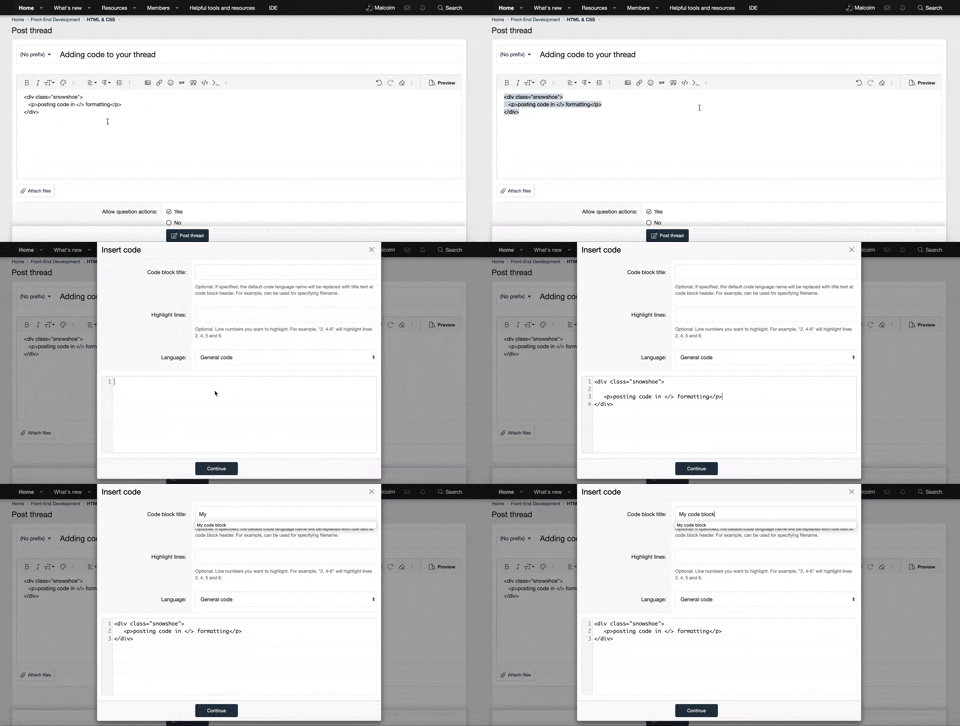
    GIF shows where to locate </> in the thread and or post editor toolbar.
    To learn more about how to use our BBCode feature, review our "How to post your code into threads" here.

    Thank you, Code Forum.

Playing Audio Using Keystrokes: Is It Possible?

Annabelle5893

Gold Coder
I'm wondering, how would I make an app that plays audio files using the keys on the number pad? Specifically, I want to make an app that triggers "Rotary Pulse 1" by pressing 1 on the numeric keypad, all the way up to "Rotary Pulse 0" on the 0 key. A dial tone will be toggled on by pressing the spacebar, which will begin with a "receiver pickup" noise. The dial tone turns off when digits are dialed via the numeric keypad. If you press the spacebar either when the dial tone is on, or after dialing a number, a "Receiver Hang Up" noise will be triggered. With the rotary dial sounds, the dial turning to the fingerhole is triggered at key down, and the release of the dial returning to the resting position will be triggered by releasing of the number corresponding to the fingerhole (1, 2, 3, 4, 5, 6, 7, 8, 9, 0). This will be accompanied by the internal sound of the dial pulses as heard in a telephone. What is the code I would use to make this audio app using HTML?
 
Is the "%20" sort of an HTML equivalent to a space in a file name?
Something like that lol. It's actually called, url encoding. It allows people to use non ASCII characters in html, in urls, and in many places. Next time you open a document on your machine with a browser, take a look the name in the directory with File Explorer, and take a look at the url in the browser 🙂


Something like that lol. It's actually called, url encoding. It allows people to use non ASCII characters in html, in urls, and in many places. Next time you open a document on your machine with a browser, take a look the name in the directory with File Explorer, and take a look at the url in the browser 🙂


The error I don't understand is where it says, "Uncaught ReferenceError: ringRing is not defined". What exactly does this mean?
 
The error I don't understand is where it says, "Uncaught ReferenceError: ringRing is not defined". What exactly does this mean?
The error message says it all 🙂.. whatever you named "ringRing" has not been defined...meaning:
1) is "ringRing" a function? If so, there is no function definition for it.
JavaScript:
//function declarations/definitions
var ringRing = function () {
    //logic goes here
}

function ringRing(string){
    //logic goes here
}

2) is "ringRing" a variable? If so, there is no declaration for it... i.e.:
JavaScript:
//any of these are variables
let ringRing = "";
var ringRing = 5;
const ringRing = [a,b,c];
 
The error message says it all 🙂.. whatever you named "ringRing" has not been defined...meaning:
1) is "ringRing" a function? If so, there is no function definition for it.
JavaScript:
//function declarations/definitions
var ringRing = function () {
    //logic goes here
}

function ringRing(string){
    //logic goes here
}

2) is "ringRing" a variable? If so, there is no declaration for it... i.e.:
JavaScript:
//any of these are variables
let ringRing = "";
var ringRing = 5;
const ringRing = [a,b,c];
Where would I put the "event listener" parameters for the key presses? Would they go after the "if" statements that tell what keys to press to trigger the audio files of the "dialing tones" of numbers? 😕
 
Where would I put the "event listener" parameters for the key presses? Would they go after the "if" statements that tell what keys to press to trigger the audio files of the "dialing tones" of numbers? 😕
They would go inside of the if statement, inside the event listener. So what you want to do is call document.onkeypress, to detect when a key has been pressed, and then once a key has been pressed, determine what key was pressed. So for example, let's say you want to detect when the spacebar is pressed.. the snippet of code would look something like this:
JavaScript:
document.onkeypress = function (event) {
    //you're going to want to use the parameter being passed in to determine what was pressed
    //since we are looking for the spacebar, we will be looking for the code 32    
    // if the event's keycode is equal to 32, then play this sound
}

As a reference: here is the link to the keycode table again 🙂
 
They would go inside of the if statement, inside the event listener. So what you want to do is call document.onkeypress, to detect when a key has been pressed, and then once a key has been pressed, determine what key was pressed. So for example, let's say you want to detect when the spacebar is pressed.. the snippet of code would look something like this:
JavaScript:
document.onkeypress = function (event) {
    //you're going to want to use the parameter being passed in to determine what was pressed
    //since we are looking for the spacebar, we will be looking for the code 32   
    // if the event's keycode is equal to 32, then play this sound
}

As a reference: here is the link to the keycode table again 🙂
So for example, it would say something like:
JavaScript:
 document.onkeydown=function(e){var key=e.keyCode?e.keyCode:e.which;document.onkeydown=function(e){var key=e.keyCode?e.keyCode:e.which;if(e.which===32){receiverRaised();}
var dialTone=new Audio('Dial Tone/USA%20Dial%20Tone.ogg');
function dial(){allowDial=true;function (){dialTone.play();
That code might look a little messed up, but I'm trying my best!
 
So for example, it would say something like:
JavaScript:
 document.onkeydown=function(e){var key=e.keyCode?e.keyCode:e.which;document.onkeydown=function(e){var key=e.keyCode?e.keyCode:e.which;if(e.which===32){receiverRaised();}
var dialTone=new Audio('Dial Tone/USA%20Dial%20Tone.ogg');
function dial(){allowDial=true;function (){dialTone.play();
That code might look a little messed up, but I'm trying my best!
very close 🙂
I do have a couple of comments for ya:
1) why do you feel like you need to use document.onkeydown?
2) if I am using a keyboard, is it safe to assume that all keys on the keyboard should be mapped to a code?
3) Follow-up from last question, why do you feel like you need to use e.which?
4) Aside from the spaces, you will also need to either a) escape (using the backslash ) or b) url encode the forward slashes if they are part of the name of the file, otherwise they will be interpreted as file paths.
 
very close 🙂
I do have a couple of comments for ya:
1) why do you feel like you need to use document.onkeydown?
2) if I am using a keyboard, is it safe to assume that all keys on the keyboard should be mapped to a code?
3) Follow-up from last question, why do you feel like you need to use e.which?
4) Aside from the spaces, you will also need to either a) escape (using the backslash ) or b) url encode the forward slashes if they are part of the name of the file, otherwise they will be interpreted as file paths.
I'm afraid I don't understand what you're asking. Escape using the backslash? What exactly does that mean? The "e.which" seems to be part of the javascript in the files that this app is loosely based on. Should I do something better than that?
 
I'm afraid I don't understand what you're asking. Escape using the backslash? What exactly does that mean? The "e.which" seems to be part of the javascript in the files that this app is loosely based on. Should I do something better than that?
in regards to the escaping
JavaScript:
var dialTone=new Audio('Dial Tone/USA%20Dial%20Tone.ogg');
"Tone/USA"... is this part of the name, or the path to the file
 
I'm afraid I don't understand what you're asking. Escape using the backslash? What exactly does that mean? The "e.which" seems to be part of the javascript in the files that this app is loosely based on. Should I do something better than that?
e.which... personally I have never used nor seen the call used... I've always seen e.target, e.keyCode, (insert the more common calls lol)...
 
e.which... personally I have never used nor seen the call used... I've always seen e.target, e.keyCode, (insert the more common calls lol)...
No wonder I haven't seen it lol... apparently it's been deprecated.
 
No wonder I haven't seen it lol... apparently it's been deprecated.
...apparently, so is keyCode
 
Is it safe to assume that "\Virtual Phone\Call Progress Tones\" is the root of your project? By this, I mean, are all your html files under this directory?
Virtual Phone is the route directory. Call Progress Tones is a subdirectory, as are "Rotary Pulse Dials", "DTMF Dials", "MF Dials", "SF Dials", and "Payphone Coin Tones". "Call Progress Tones" has "Dial Tone", "Busy Tone", "Reorder Tone", "Ringback Tone" (referring to the internal ring heard in the handset), and "Ringing Tones" (Referring to the External ring, heard on the called party's phone). Within "Call Progress Tones" are also "Telephone Pickups and Hangups" which has two subdirectories, Internal and External, and last but definitely not least, there's a subdirectory in Call Progress Tones called "Receiver Off Hook Tone", and one called "Vacant Level Tone". If you know what I mean.
 
Is it safe to assume that "\Virtual Phone\Call Progress Tones\" is the root of your project? By this, I mean, are all your html files under this directory?
How about this? How does this look for an "src" example?
HTML:
<audio id="RingingTone" src="file:///M:/Documents/Virtual%20Phone/Call%20Progress%20Tones/Ringing%20Tone/Princess%20702B%20Bell%20Ring.ogg"></audio>
 
Back
Top Bottom