Welcome to Code Forum!

Join a community that supports you and your coding journey from day one. We strive to be a friendly, supportive community that empowers everyone to be better developers. By registering with us, you'll be able to discuss, share and private message with other members of our community.

SignUp Now!
  • Guest, before posting your code please take these rules into consideration:
    • It is required to use our BBCode feature to display your code. While within the editor click < / > or >_ and place your code within the BB Code prompt. This helps others with finding a solution by making it easier to read and easier to copy.
    • You can also use markdown to share your code. When using markdown your code will be automatically converted to BBCode. For help with markdown check out the markdown guide.
    • Don't share a wall of code. All we want is the problem area, the code related to your issue.

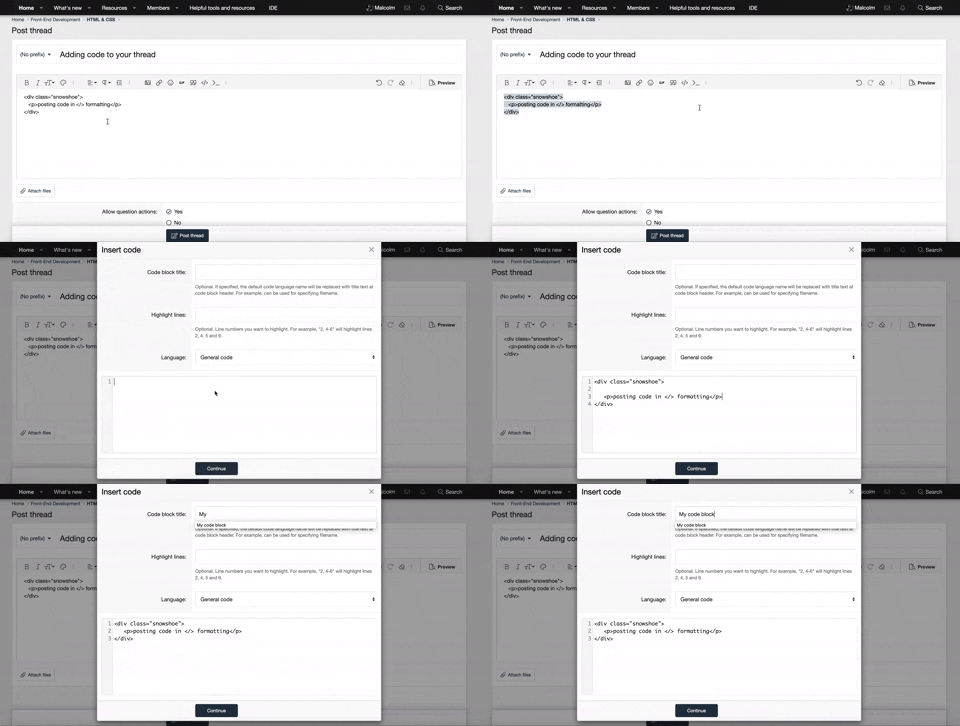
    GIF shows where to locate </> in the thread and or post editor toolbar.
    To learn more about how to use our BBCode feature, review our "How to post your code into threads" here.

    Thank you, Code Forum.

Python The best Pickup Delivery Vehicle Routing Problem

Solution
I challenge you to write a paragraph describing the kind of routing problem your program solves.

I had a quick look on git hub, but I don't fancy reading all your files.

I'm lazy like that.
Fully agree with this statement as the GitHub documentation is a mess

A simple project description would help…for example:

### Problem Statement:
- Objective: Minimize total travel distance while fulfilling pickup and delivery tasks with a fleet of vehicles.

### Important Parameters:
  • Number of Vehicles: \( N \) vehicles available for routing.
  • Vehicle Capacity: Maximum weight/volume a vehicle can carry (e.g., 100 kg or 10 items).
  • Locations:
- Depot: Starting and ending...
I challenge you to write a paragraph describing the kind of routing problem your program solves.

I had a quick look on git hub, but I don't fancy reading all your files.

I'm lazy like that.
Fully agree with this statement as the GitHub documentation is a mess

A simple project description would help…for example:

### Problem Statement:
- Objective: Minimize total travel distance while fulfilling pickup and delivery tasks with a fleet of vehicles.

### Important Parameters:
  • Number of Vehicles: \( N \) vehicles available for routing.
  • Vehicle Capacity: Maximum weight/volume a vehicle can carry (e.g., 100 kg or 10 items).
  • Locations:
- Depot: Starting and ending point for all vehicles.
- Pickup Locations: Locations where items are picked up.
- Delivery Locations: Locations where items are delivered.
  • Distance Matrix: Distance (or time) between each pair of locations (including depot, pickups, and deliveries).
  • Pickup and Delivery Pairing: Each pickup must be paired with a corresponding delivery.

### Constraints:
  • Pickup and Delivery Pairing: Each pickup must be followed by its corresponding delivery (same vehicle).
  • Vehicle Capacity: A vehicle’s total load must not exceed its capacity (in weight or volume).
  • Route Validity: Vehicles must follow feasible routes without violating vehicle capacity or constraints.
  • Depot Return: Each vehicle must return to the depot after completing all tasks.
  • Minimize Total Distance: The goal is to minimize the total distance traveled by all vehicles combined.

### Optional Constraints:
- Time Windows (if applicable):
- Pickup and/or delivery tasks must occur within specific time windows.
- Time-Dependent Travel (if applicable):
- Travel time between locations can vary based on the time of day (e.g., traffic conditions).

### Expected Output:
  • Routes for each vehicle: The order of visits for each vehicle (e.g., Depot → Pickup → Delivery → Depot).
  • Total Distance: The total travel distance for all vehicles combined.
 
Last edited:
Solution
I have now added a comprehensive readme file to the GitHub repository. I will post it here as well:

Pickup and Delivery Vehicle Routing Problem Project Overview This project implements advanced metaheuristic algorithms for solving the Maritime Pickup and Delivery Vehicle Routing Problem with Time Windows (PDPTW). The problem involves optimizing routes for a fleet of heterogeneous vessels to serve transportation requests (calls) between different ports, while respecting various operational constraints.

We are given:

A fleet of heterogeneous vessels (vehicles) with different capacities, speeds, and cost structures A set of transportation requests (calls), each consisting of: A pickup location and time window A delivery location and time window A cargo size A penalty cost for not serving the call Travel costs between ports, which may vary by vessel Port operation costs for loading/unloading cargo Time window constraints for pickup and delivery operations

The objective is to find a feasible assignment of calls to vessels and determine the sequence of port visits that minimizes the total cost.

The total cost includes: Travel costs between ports Port operation costs Penalty costs for unserved calls (assigned to the dummy vehicle)

Constraints: Each call must be picked up before it can be delivered Each call must be served by exactly one vessel or left unserved (assigned to the dummy vehicle) Vessel capacity constraints must be respected at all times Time window constraints for pickup and delivery operations must be adhered to Some calls may only be compatible with certain vessels

This project implements several metaheuristic algorithms:

Adaptive Large Neighborhood Search (ALNS): The primary algorithm, which uses multiple removal and insertion operators with adaptive weights based on their performance.

Simulated Annealing: A temperature-based approach that allows accepting worse solutions with a decreasing probability over time.

Local Search: A hill-climbing approach that only accepts improvements but can get stuck in local optima.

Blind Random Search: A baseline method for comparison.

Key Components Removal Operators: Random Removal: Removes random calls from the solution Related Removal: Removes calls that are related based on spatial proximity, time windows, and cargo size Worst Removal: Removes calls that contribute most to the solution cost Dummy Removal: Strategically removes calls from the dummy vehicle to try reinserts

Insertion Operators: Random Insertion: Inserts calls at random feasible positions Regret Insertion: Prioritizes calls with higher "regret" value if not inserted now Greedy Insertion: Inserts calls at their best feasible positions Limited Permutation Insertion: Considers permutations of nearby calls to find better arrangements

The algorithm dynamically adjusts operator weights based on their performance, favoring operators that:

Produce feasible solutions Improve the current solution Find new best solutions Code Structure

Assignment5.py: Main implementation of the adaptive algorithm and operators Utils.py: Utility functions for the problem function_tester.py: Framework for testing different algorithms on multiple problem instances

To customize the run parameters, modify the run() function in function_tester.py.

The algorithm is tested on multiple problem instances with varying sizes:

Call_7_Vehicle_3 (small) Call_18_Vehicle_5 (medium) Call_35_Vehicle_7 (large) Call_80_Vehicle_20 (very large) Call_130_Vehicle_40 (extremely large) Call_300_Vehicle_90 (massively large)

Results are recorded in results_history.csv including:

Best solution found Average solution quality Runtime performance Improvement over initial solutions
 
I have now added a comprehensive readme file to the GitHub repository. I will post it here as well:

Pickup and Delivery Vehicle Routing Problem Project Overview This project implements advanced metaheuristic algorithms for solving the Maritime Pickup and Delivery Vehicle Routing Problem with Time Windows (PDPTW). The problem involves optimizing routes for a fleet of heterogeneous vessels to serve transportation requests (calls) between different ports, while respecting various operational constraints.

We are given:

A fleet of heterogeneous vessels (vehicles) with different capacities, speeds, and cost structures A set of transportation requests (calls), each consisting of: A pickup location and time window A delivery location and time window A cargo size A penalty cost for not serving the call Travel costs between ports, which may vary by vessel Port operation costs for loading/unloading cargo Time window constraints for pickup and delivery operations

The objective is to find a feasible assignment of calls to vessels and determine the sequence of port visits that minimizes the total cost.

The total cost includes: Travel costs between ports Port operation costs Penalty costs for unserved calls (assigned to the dummy vehicle)

Constraints: Each call must be picked up before it can be delivered Each call must be served by exactly one vessel or left unserved (assigned to the dummy vehicle) Vessel capacity constraints must be respected at all times Time window constraints for pickup and delivery operations must be adhered to Some calls may only be compatible with certain vessels

This project implements several metaheuristic algorithms:

Adaptive Large Neighborhood Search (ALNS): The primary algorithm, which uses multiple removal and insertion operators with adaptive weights based on their performance.

Simulated Annealing: A temperature-based approach that allows accepting worse solutions with a decreasing probability over time.

Local Search: A hill-climbing approach that only accepts improvements but can get stuck in local optima.

Blind Random Search: A baseline method for comparison.

Key Components Removal Operators: Random Removal: Removes random calls from the solution Related Removal: Removes calls that are related based on spatial proximity, time windows, and cargo size Worst Removal: Removes calls that contribute most to the solution cost Dummy Removal: Strategically removes calls from the dummy vehicle to try reinserts

Insertion Operators: Random Insertion: Inserts calls at random feasible positions Regret Insertion: Prioritizes calls with higher "regret" value if not inserted now Greedy Insertion: Inserts calls at their best feasible positions Limited Permutation Insertion: Considers permutations of nearby calls to find better arrangements

The algorithm dynamically adjusts operator weights based on their performance, favoring operators that:

Produce feasible solutions Improve the current solution Find new best solutions Code Structure

Assignment5.py: Main implementation of the adaptive algorithm and operators Utils.py: Utility functions for the problem function_tester.py: Framework for testing different algorithms on multiple problem instances

To customize the run parameters, modify the run() function in function_tester.py.

The algorithm is tested on multiple problem instances with varying sizes:

Call_7_Vehicle_3 (small) Call_18_Vehicle_5 (medium) Call_35_Vehicle_7 (large) Call_80_Vehicle_20 (very large) Call_130_Vehicle_40 (extremely large) Call_300_Vehicle_90 (massively large)

Results are recorded in results_history.csv including:

Best solution found Average solution quality Runtime performance Improvement over initial solutions
Looks much better
 
Back
Top Bottom