
ratwolf
Bronze Coder

A different way to look at one of mathematics’ most stubborn problem
A useful way to think about the Collatz map is to separate the orbit into two layers: the parity pattern of the terms and the arithmetic values that carry that pattern.The Accelerated Collatz Formulation
This perspective uses the accelerated (or shortcut) version of the Collatz map rather than the classical 3n+1 rule:- If n is even: next = n / 2
- If n is odd: next = (3n + 1) / 2
By combining the “3n+1” and the immediate division by 2 into one step, each move now corresponds directly to one bit in the parity word
(0 = even step, 1 = odd step).
For the famous starting value 27, the classical orbit takes 111 steps, while the accelerated version reaches 1 in 71 steps. This produces a cleaner, more compact representation.
What This Perspective Is
This viewpoint is best understood as a reformulation. It highlights that:• The Collatz map can be studied through its parity pattern.
• The parity sequence records the symbolic dynamics of the accelerated orbit.
• The arithmetic constraints are transferred to the admissibility of the symbolic encoding.
In short, the problem becomes: Which binary sequences can actually arise from ordinary integers?
Equivalently, the central question becomes one of admissibility: which infinite binary sequences are compatible with valid Collatz orbits?
Relation to Existing Approaches
The use of parity sequences in Collatz research is well established and has appeared in several classical treatments of the problem. The emphasis here is not on introducing a new encoding, but on viewing the parity sequence as a separate symbolic layer — a “shadow” of the arithmetic orbit — that provides a convenient conceptual and visual framework. The arithmetic difficulty then appears as the problem of determining which symbolic sequences are admissible for integer orbits.
What This Perspective Is Not
It does not solve the Collatz conjecture, prove convergence, or introduce a new dynamical system. Rather, it is a reformulation that separates the symbolic and arithmetic aspects of the accelerated map. While the symbolic representation is simple, the admissibility conditions imposed by arithmetic remain highly nontrivial.Why It Is Still Valuable
This perspective offers:- A compact symbolic representation of any orbit
- Clear separation between combinatorial and arithmetic aspects
- Natural links to symbolic dynamics and 2-adic numbers
Visualizing the Shadow
Here are the 3 figures that illustrate the ideaAll figures were generated by the author using Python:
Press enter or click to view image in full size
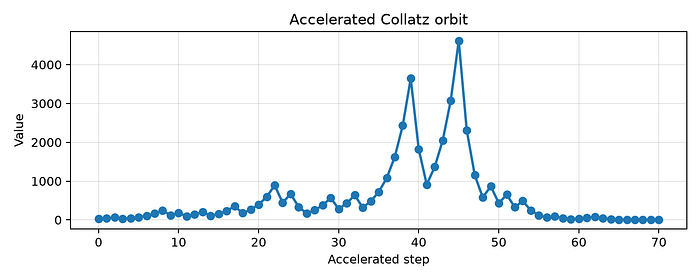
Figure 1: Accelerated Collatz Orbit
Shows the numerical values of the accelerated sequence starting from 27. The classic ups and downs of Collatz are clearly visible.
Press enter or click to view image in full size
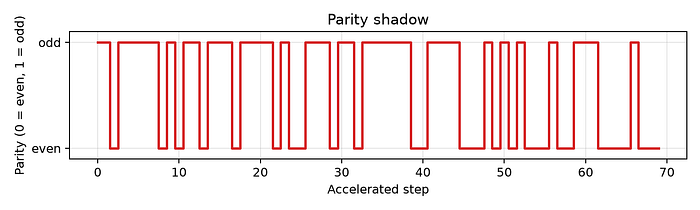
Figure 2: Parity Shadow
The binary parity word — the symbolic “shadow” of the orbit. Each step is either 0 (even) or 1 (odd).
Press enter or click to view image in full size
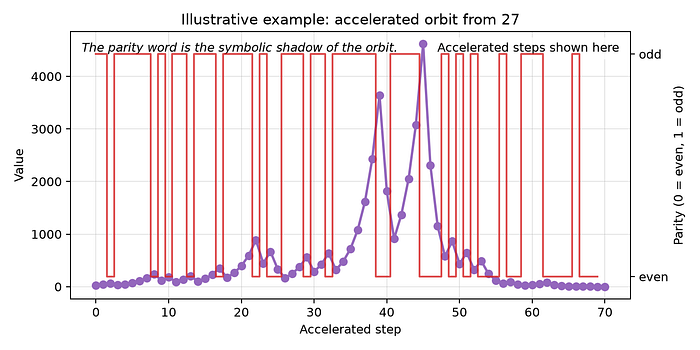
Figure 3: Illustrative Example (n = 27)
A detailed view combining the orbit and its parity shadow with explanatory annotations.
Final Thoughts
This “Shadow View” does not claim to solve the Collatz conjecture. Instead, it offers a clearer, more structured lens through which to view this famously difficult problem.A serious way to state the idea is:
The parity sequence records the symbolic dynamics of the accelerated orbit, while the arithmetic constraints determine which symbolic sequences are realized by integer orbits. This reformulation does not simplify the arithmetic difficulty of the Collatz conjecture, but it separates the symbolic and numerical aspects into distinct layers. In this sense, the parity sequence acts as a symbolic “shadow” of the orbit, providing a structured way to visualize and analyze Collatz dynamics without claiming a solution to the underlying problem.
Want to Explore More?
The journey doesn’t stop here.
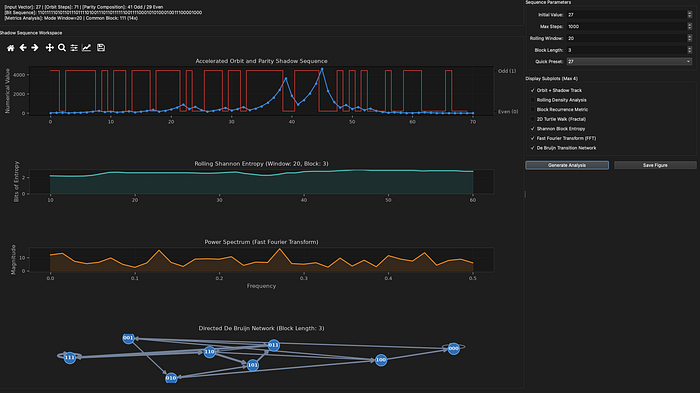
Shadow_Explorer
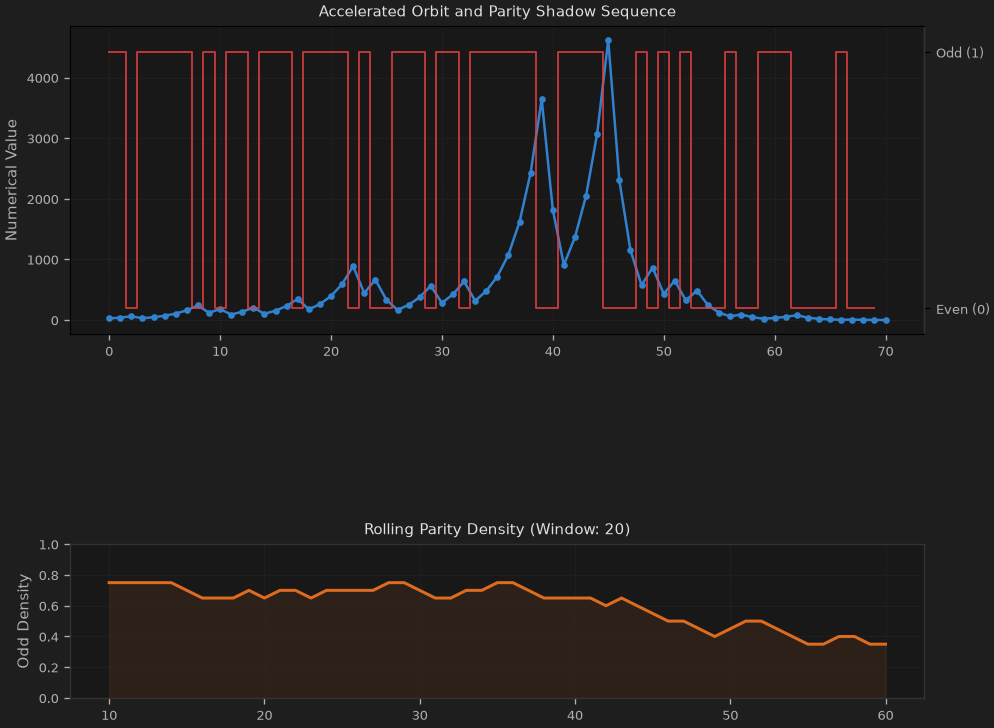
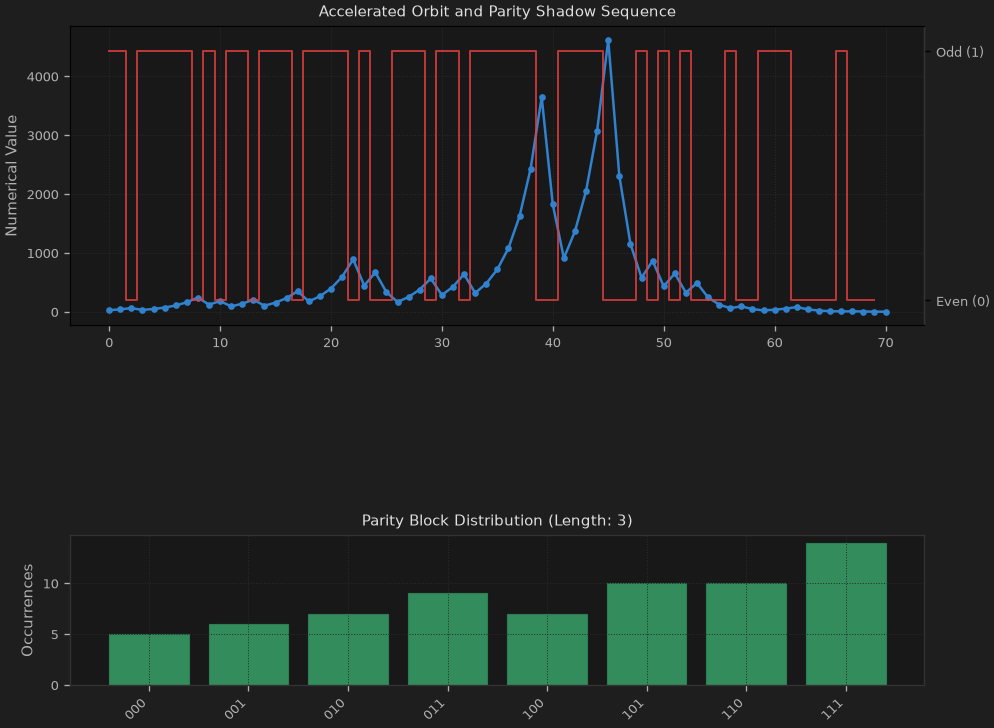
e
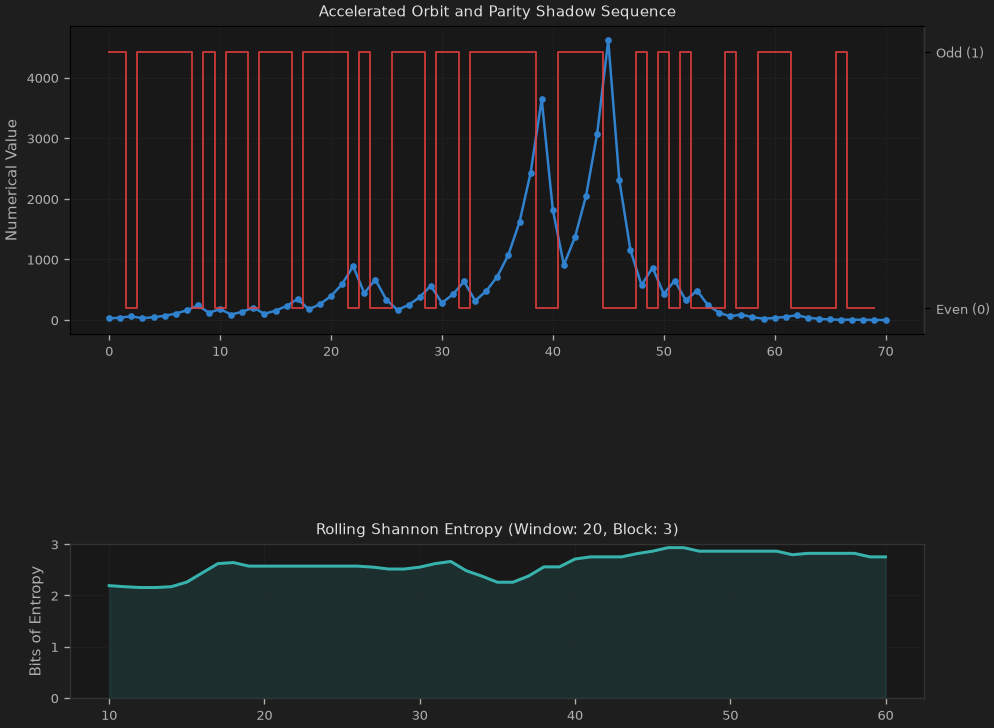
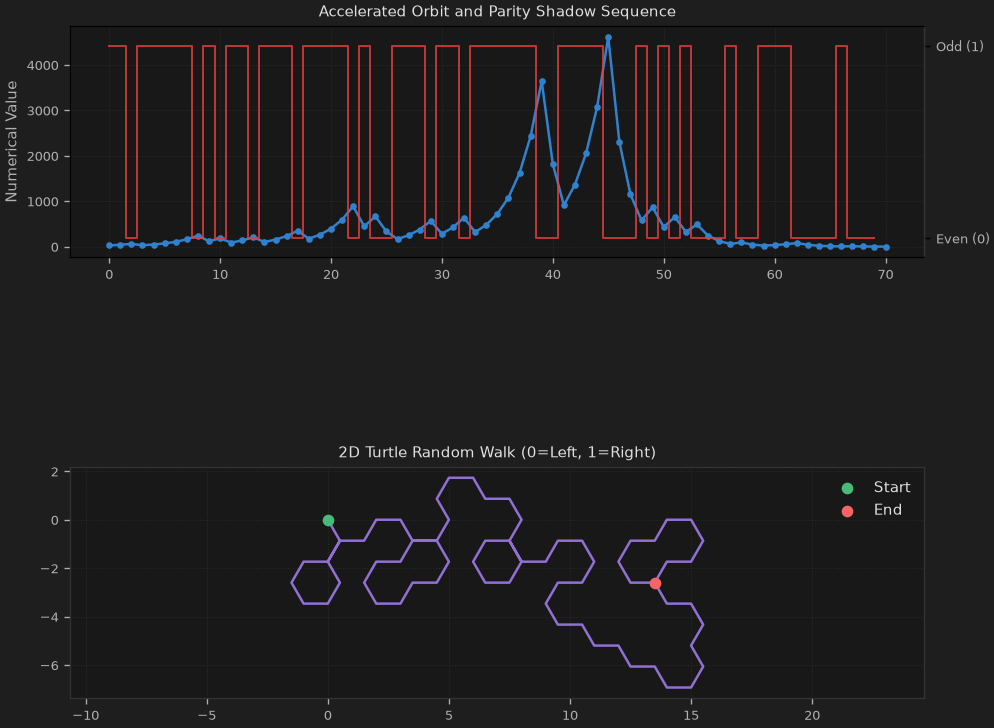
e
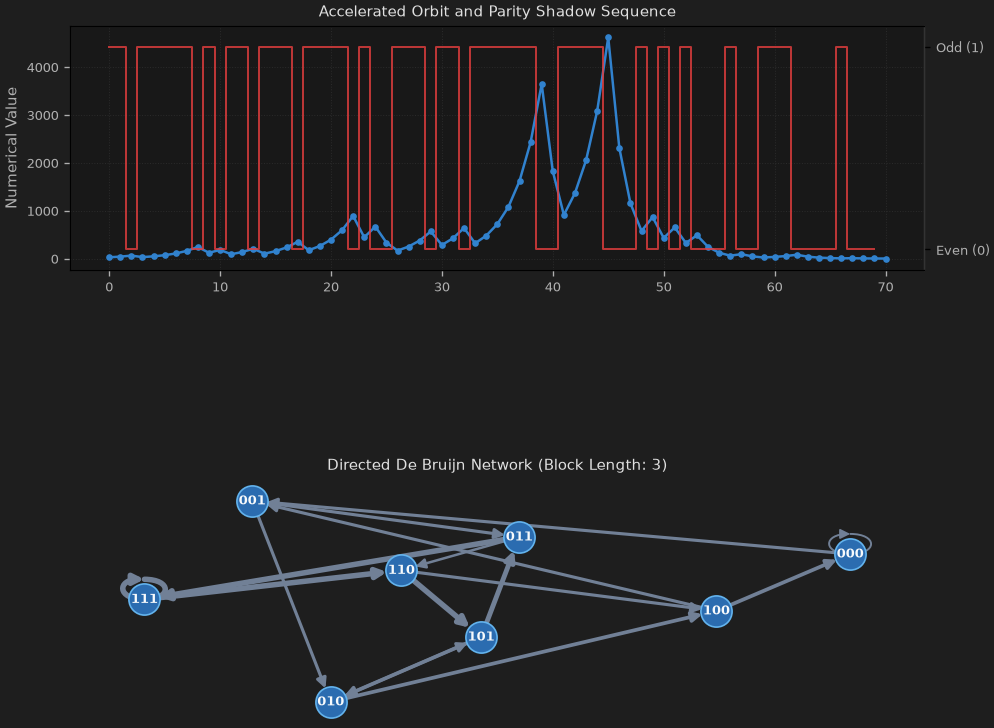
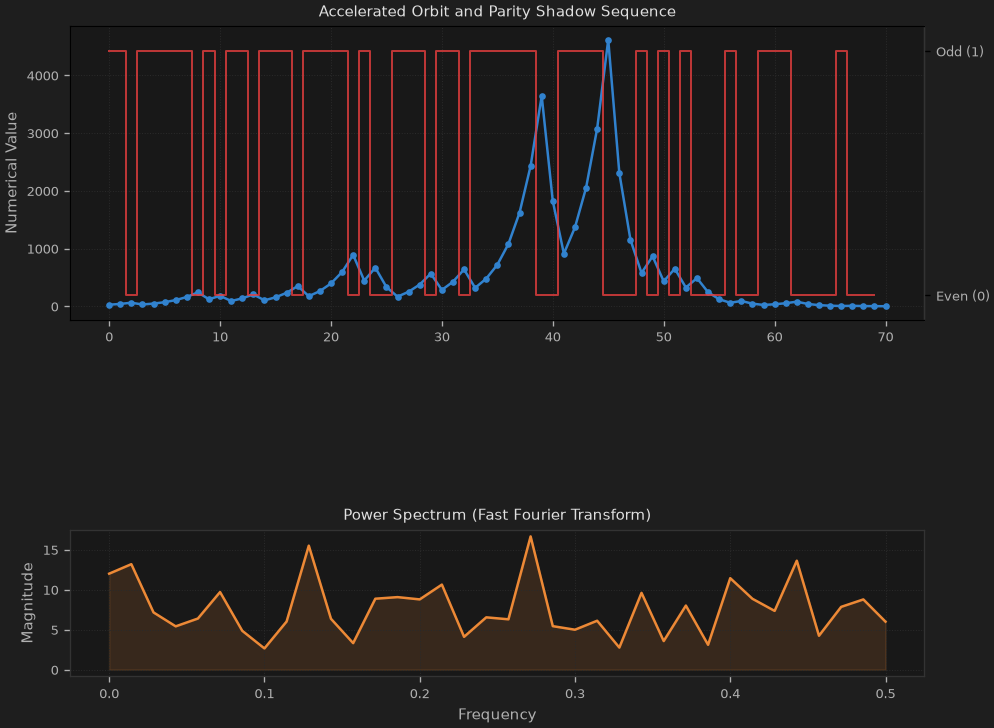
The application provides several lenses through which to study the sequence:
- Orbit + Shadow Track: The fundamental view. It overlays the numeric orbit (the arithmetic layer) with the binary parity sequence (the symbolic layer) on the same step axis.
- Rolling Density Analysis: Displays the ratio of odd to even steps over a sliding window, highlighting localized phases of growth or decay.
- Block Recurrence Metric: A histogram showing the frequency of k-length binary blocks (e.g., how often
011or101occurs), revealing combinatorial constraints. - 2D Turtle Walk (Fractal): Treats the parity word as directional instructions (0 = Left, 1 = Right) on a 2D plane. This maps the sequence to spatial geometry, often revealing structural symmetries hidden in the linear data.
- Shannon Block Entropy: Measures the informational unpredictability of the sequence over time. It highlights chaotic phases versus highly ordered phases as the orbit collapses toward 1.
- Fast Fourier Transform (FFT): Calculates the power spectrum of the 0–1 signal, allowing you to check for dominant frequencies or periodic harmonics in the shadow word.
- De Bruijn Transition Network: A directed network graph of parity block transitions. It visualizes the chronological “flow” of the sequence, essentially mapping the pathways that drain into the standard 4–2–1 attractor.
- more see development folder on GitHub
References and Further Reading
- Terras, R. (1976). A stopping time problem on the positive integers. Acta Arithmetica, 30(3), 241–252.
- Tao, T. (2019). Almost all Collatz orbits attain almost bounded values. arXiv:1909.03562.
[arXiv link](Almost all orbits of the Collatz map attain almost bounded values) - Lagarias, J. C. (Ed.). (2010). The Ultimate Challenge: The 3x + 1 Problem. American Mathematical Society.
[AMS Bookstore](The Ultimate Challenge: The $3x+1$ Problem)
- The Terras link points to the European Digital Mathematics Library (EuDML), which hosts a free, open-access scan of the original 1976 paper.
- The Tao link points directly to the official arXiv repository page where readers can download the PDF for free.
- The Lagarias link directs to the official American Mathematical Society (AMS) bookstore page for the volume.
Last edited:




