ratwolf
Bronze Coder

Abstract
This paper introduces a compact three-parameter framework for characterizing the local geometry of polynomial roots.DOI (Zenodo)
For each root, the framework records its position, its algebraic multiplicity, and a newly defined quantity called the characteristic deflection distance. This third parameter acts as a natural geometric scale: it measures
how sharply or gradually the polynomial departs from zero in the immediate vicinity of the root, and it encodes the collective influence of all other roots through their distances from the one being analyzed.
The characteristic deflection distance generalizes the classical condition number of a simple root to roots of arbitrary multiplicity, and it allows direct geometric comparison across roots of different degrees. A key finding is that multiplicity alone does not determine geometric dominance — a lower-multiplicity root can have a larger spatial footprint than a higher-multiplicity one, depending on the global root configuration.
Global Visualization: Newton Flow and δ-Root Fields
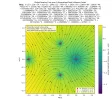
To visualize the global interaction of these triplets, we map the
𝛿-Normalized Distance Fieldand the Newton Flow. This provides a “topographical” view of the polynomial’s geometry where every root is evaluated against its own intrinsic scale.
GitHub
Observation
In the resulting visualization, the streamlines reveal the basin of attraction for each root, while the background color reveals the geometric footprint. Notice that a root with a large 𝛿 exerts a wider “influence” on the distance field, even if its multiplicity 𝑚 is lower than neighboring roots.
Last edited: