
ratwolf
Bronze Coder
The Universe Never Forgets — It Just Grows
A Mathematical Thought Experiment at the Edge of Physics
Check out the full proposal and Python simulation at The Golomb UniverseQuantum mechanics insists that information is never lost. Yet, we see coffee cool, stars fade, and time march forward — processes that seem irreversible. This tension, which I propose to call the “quantum memory paradox,”, suggests a deeper truth about reality’s structure. What if the universe doesn’t reverse time to preserve information but instead grows its very framework, encoding every moment in an ever-expanding ledger? This thought experiment, the Golomb Universe, proposes that reality emerges from a simple, deterministic rule, weaving time, space, and matter from a single principle: unique distinctions.
⌛ The “Quantum Memory Paradox”
At the smallest scales, quantum mechanics demands that information is preserved — a principle called unitarity. But in our everyday world, thermodynamics suggests irreversibility: entropy increases, and processes like a cooling cup of coffee seem to lose information. This paradox — microscopic reversibility versus macroscopic irreversibility — hints at a universe that records its history not by reversing but by growing. The Golomb Universe model explores this idea, using a mathematical structure called a Golomb ruler to encode reality’s memory.The Golomb Ruler: Reality’s Memory Device
Imagine a ruler with marks at specific points, like [0, 1, 3, 7].Measure the distances between every pair of marks:
- 1 = 1 - 0
- 2 = 3 - 1
- 3 = 3 - 0
- 4 = 7 - 3
- 6 = 7 - 1
- 7 = 7 - 0
 Image by the author
In the “Golomb Universe” model, this combinatorial uniqueness isn’t just a mathematical curiosity; it’s the fundamental principle of reality.
💡 The Universe’s Growth Rule: Minimalist and Deterministic
Picture a universe starting from a void with no distinctions.It begins with a single mark, [0], then adds another, [0, 1], creating the first difference {1}.
The next mark, 3, forms [0, 1, 3], adding new differences {2, 3}.
To add the next mark, the universe follows a strict rule: choose the smallest number that creates only new, unique differences.
For [0, 1, 3], with differences {1, 2, 3}, the next mark can’t be 4 (4–1=3, already used) or 5 (5–3=2, already used). The smallest valid mark is 7, yielding [0, 1, 3, 7] with new differences {4, 6, 7}.
This process generates a unique, infinite sequence:
[0, 1, 3, 7, 12, 20, 30, 44, …]
Each step is deterministic, ensuring the universe’s memory scales perfectly, with every “event” (difference) indelibly recorded in its structure.
From Distinctions to Dimensions
As distinctions accumulate, the universe doesn’t just grow in a straight line — it builds dimensions. Simulations reveal that at specific points the structure transitions to higher dimensions. This emergent geometry arises from the pattern of differences, not a pre-existing space. Time, space, and even quantum behavior emerge as follows:- 🕰️ Time as Irreversible Ledger: Time is the sequence of adding unique marks, each step building on the last, never reversible.
- 🌌 Space as Emergent Geometry: Spatial dimensions (2D, 3D, 4D) emerge when the complexity of distinctions requires more than a 1D line, governed by mathematical patterns in the differences.
- 📂 Memory as Structural Encoding: The universe’s current structure is its full history — no external storage needed.
- 🔥 Entropy as Growing Complexity: Entropy counts the number of unique distinctions, reflecting the universe’s increasing depth, not disorder.
- 🚀 Light Speed as Causal Limit: The maximum rate at which new distinctions influence each other may define the speed of light.
- ⚛️ Quantum Behavior as Structural Choice: Before a “measurement,” multiple marks could fit the uniqueness rule; the universe selects the minimal one, mimicking quantum outcomes without probabilities.
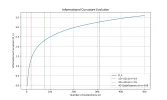
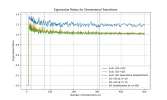
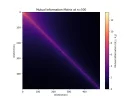
Images by the author
❌ Testing the Golomb Universe
This model isn’t just a thought experiment — it’s falsifiable. If physical data, like redshift patterns in cosmological surveys or time intervals in gravitational wave events, show repeated relational differences (e.g., two quasar pairs with identical redshift separations), the model fails. Specific predictions include:- Spectral Gaps: Energy differences in quantum systems should reflect the informational scale of distinctions.
- CMB Fluctuations: The cosmic microwave background may show discrete “informational modes” tied to the model’s structure.
🌠 The Big Picture
The Big Picture
The Golomb Universe suggests reality is an infinite ledger where:- Quantum rules preserve information through unique distinctions.
- Thermodynamics drives the addition of new “pages.”
- Structural growth ensures perfect recall across dimensions.
You don’t see the ruler — but you feel its pull.
🧠 For Curious Minds
This framework builds on a formal system combining logic, category theory, and mathematics, detailed in the full proposal. It predicts specific dimensional transitions (e.g., 4D spacetime at 308 distinctions) and derives spacetime dynamics resembling general relativity. While still a theoretical proposal, it connects to ideas like causal set theory and offers a path to a combinatorial quantum gravity, where reality weaves itself from a single, elegant rule.Want to explore more? Check out the full proposal and Python simulation at The Golomb Universe.
📎 The Golomb Universe
Last edited:




