Welcome to Code Forum!

Join a community that supports you and your coding journey from day one. We strive to be a friendly, supportive community that empowers everyone to be better developers. By registering with us, you'll be able to discuss, share and private message with other members of our community.

SignUp Now!
  • Guest, before posting your code please take these rules into consideration:
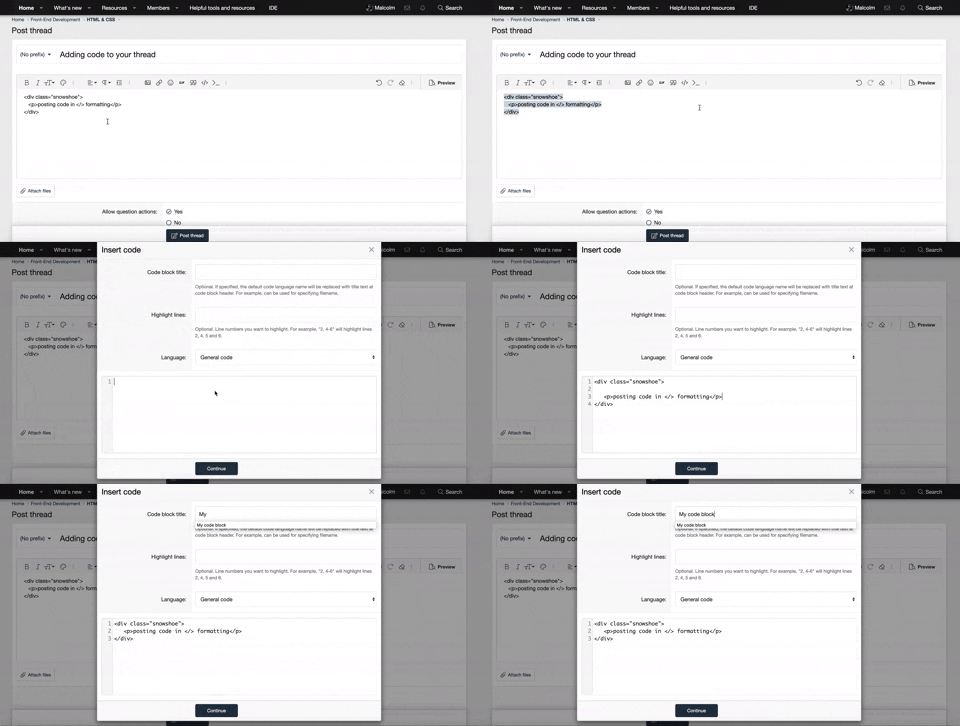
    • It is required to use our BBCode feature to display your code. While within the editor click < / > or >_ and place your code within the BB Code prompt. This helps others with finding a solution by making it easier to read and easier to copy.
    • You can also use markdown to share your code. When using markdown your code will be automatically converted to BBCode. For help with markdown check out the markdown guide.
    • Don't share a wall of code. All we want is the problem area, the code related to your issue.

    GIF shows where to locate </> in the thread and or post editor toolbar.
    To learn more about how to use our BBCode feature, review our "How to post your code into threads" here.

    Thank you, Code Forum.

Best Practices for Modern Web Design: Tips and Insights?

kemiy

Bronze Coder
Hi everyone,

I’m looking to improve my web design skills and wanted to get some advice from this community. I’m particularly interested in modern trends, responsive design, and UX/UI best practices.

How do you balance aesthetics with functionality, especially on mobile devices? Are there any frameworks, tools, or resources you swear by for creating clean, user-friendly websites? Additionally, I’m curious about optimizing site performance without compromising design quality.

Any tips, examples, or personal experiences would be greatly appreciated.

How do you stay updated with evolving design standards and technologies in web development?
 
Hi everyone,

I’m looking to improve my web design skills and wanted to get some advice from this community. I’m particularly interested in modern trends, responsive design, and UX/UI best practices.

How do you balance aesthetics with functionality, especially on mobile devices? Are there any frameworks, tools, or resources you swear by for creating clean, user-friendly websites? Additionally, I’m curious about optimizing site performance without compromising design quality.

Any tips, examples, or personal experiences would be greatly appreciated.

How do you stay updated with evolving design standards and technologies in web development, especially when working on Kelowna web design projects?
thanks in advance for any help
 
Hi everyone,

I’m looking to improve my web design skills and wanted to get some advice from this community. I’m particularly interested in modern trends, responsive design, and UX/UI best practices.

How do you balance aesthetics with functionality, especially on mobile devices? Are there any frameworks, tools, or resources you swear by for creating clean, user-friendly websites? Additionally, I’m curious about optimizing site performance without compromising design quality.

Any tips, examples, or personal experiences would be greatly appreciated.

How do you stay updated with evolving design standards and technologies in web development?

For balancing functionality with aesthetics, embracing simplicity via minimalism and the use of white space improve readability and aren't as distracting for the site visitor, as well as aid the user's focus toward key elements. For aesthetic, use color, contrast, and size to make the crucial information stand out. Using a system likes this takes the visitor's attention away from redundant elements and redirects it to help them quickly find what they're looking for. For functionality, prioritize content and assure only the most vital information is delivered first. It captures your viewer's attention for longer and extends their time on your website. Add micro-interactions such as button clicks or questionnaires to keep your viewers engaged. This has the added benefit of making the interface feel alive and responsive.

Use modern frameworks to help produce efficient and effective websites. A few I would recommend for design and wireframing are Figma (a UI/UXm cloud-based design tool that supports online collaboration), and Tailwind CSS (allows for rapid development by providing low-level utility classes directly in HTML code. It is highly customizable).

For frontend development, I don't have much experience with it.., but I can at least recommend to you React (a JavaScript library) and Vue.js (a simplistic and flexible framework). From what I remember, Vue.js and other programs such as Astro can significantly improve initial load times by delivering fully rendered HTML code to the viewer's browser.

Finally, for optimizing site performance, compress images/videos to reduce file size without losing quality by using formats such as AVIF and WebP. Minify code to remove unnecessary characters from CSS and HTML stanzas, and choose fast hosting by investing in a quality web host.

Hope this helps.
 
For balancing functionality with aesthetics, embracing simplicity via minimalism and the use of white space improve readability and aren't as distracting for the site visitor, as well as aid the user's focus toward key elements. For aesthetic, use color, contrast, and size to make the crucial information stand out. Using a system likes this takes the visitor's attention away from redundant elements and redirects it to help them quickly find what they're looking for. For functionality, prioritize content and assure only the most vital information is delivered first. It captures your viewer's attention for longer and extends their time on your website. Add micro-interactions such as button clicks or questionnaires to keep your viewers engaged. This has the added benefit of making the interface feel alive and responsive.

Use modern frameworks to help produce efficient and effective websites. A few I would recommend for design and wireframing are Figma (a UI/UXm cloud-based design tool that supports online collaboration), and Tailwind CSS (allows for rapid development by providing low-level utility classes directly in HTML code. It is highly customizable).

For frontend development, I don't have much experience with it.., but I can at least recommend to you React (a JavaScript library) and Vue.js (a simplistic and flexible framework). From what I remember, Vue.js and other programs such as Astro can significantly improve initial load times by delivering fully rendered HTML code to the viewer's browser.

Finally, for optimizing site performance, compress images/videos to reduce file size without losing quality by using formats such as AVIF and WebP. Minify code to remove unnecessary characters from CSS and HTML stanzas, and choose fast hosting by investing in a quality web host.

Hope this helps.

I'll add that if you are learning front-end development, it's very important to learn CSS before using something like Tailwind so you have the knowledge you need to understand what it's doing and be able to competently troubleshoot it.
 
I'll add that if you are learning front-end development, it's very important to learn CSS before using something like Tailwind so you have the knowledge you need to understand what it's doing and be able to competently troubleshoot it.

Ah yes, thank you---I forgot to elaborate on that. Tailwind is an inherent CSS framework. It's an abstraction, not a replacement. Learning vanilla CSS is crucial for avoiding confusion and for customization, but troubleshooting especially, as @tomliv mentioned.

Luckily, there are numerous tips you can use to make Tailwind easier. Tailwind has exceptional documentation, so use it to your advantage to correct utility classes and understand their purpose. Additionally, (if you're a VSC user) installing the IntelliSense extension can aid in your development workflow by providing a number of benefits including syntax highlighting and autocompletion.
 
Back
Top Bottom