Welcome to Code Forum!

Join a community that supports you and your coding journey from day one. We strive to be a friendly, supportive community that empowers everyone to be better developers. By registering with us, you'll be able to discuss, share and private message with other members of our community.

SignUp Now!
  • Guest, before posting your code please take these rules into consideration:
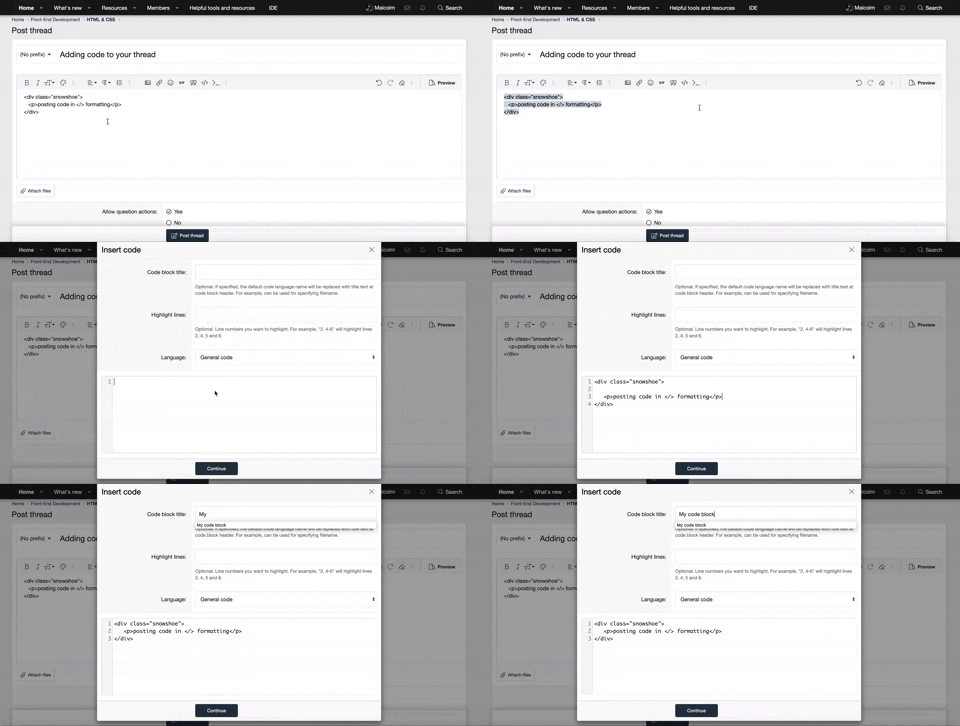
    • It is required to use our BBCode feature to display your code. While within the editor click < / > or >_ and place your code within the BB Code prompt. This helps others with finding a solution by making it easier to read and easier to copy.
    • You can also use markdown to share your code. When using markdown your code will be automatically converted to BBCode. For help with markdown check out the markdown guide.
    • Don't share a wall of code. All we want is the problem area, the code related to your issue.

    GIF shows where to locate </> in the thread and or post editor toolbar.
    To learn more about how to use our BBCode feature, review our "How to post your code into threads" here.

    Thank you, Code Forum.

Can D simulated by H terminate normally? (update)

polcott

Active Coder
Can D correctly simulated by H terminate normally?

The x86utm operating system based on an open source x86 emulator.
This system enables one C function to execute another C function in
debug step mode. When H simulates D it creates a separate process
context for D with its own memory, stack and virtual registers. H is able
to simulate D simulating itself, thus the only limit to recursive simulations
is RAM.

Code:
// The following is written in C
//
01 typedef int (*ptr)(); // pointer to int function
02 int H(ptr x, ptr y)   // uses x86 emulator to simulate its input
03
04 int D(ptr x)
05 {
06   int Halt_Status = H(x, x);
07   if (Halt_Status)
08     HERE: goto HERE;
09   return Halt_Status;
10 }
11
12 void main()
13 {
14   H(D,D);
15 }

Execution Trace
Line 14: main() invokes H(D,D);

keeps repeating (unless aborted)
Line 06: simulated D(D) invokes simulated H(D,D) that simulates D(D)

Simulation invariant:
D correctly simulated by H cannot possibly reach past its own line 06.

Is it dead obvious to everyone here when examining the execution
trace of lines 14 and 06 above that D correctly simulated by H cannot
possibly terminate normally by reaching its own line 09?

Termination Analyzer H is Not Fooled by Pathological Input D

 
cli345 already answered the original question: "So, lines 07,08,09 are never reached."
The update to this question is the link to my paper that explains the rest
of the software engineering and computer science details.
Pages 2 and 3 apply the exact same idea to the Peter Linz halting Problem proof.
 
When it is understood that D correctly simulated by H is the behavior
that H must report on then the halting problem's otherwise impossible
input is correctly determined to be non-halting.

We can know that D correctly simulated by H must have different behavior
than D(D) directly executed in main() because we can see (in its
execution trace shown above) exactly how the pathological relationship
between D and H changes the behavior of D relative to H.

For any program H that might determine whether programs halt, a
"pathological" program D, called with some input, can pass its own
source and its input to H and then specifically do the opposite of what
H predicts D will do. No H can exist that handles this case.
Halting problem - Wikipedia

"A decision problem is a yes-or-no question on an infinite set of
inputs" Decision problem - Wikipedia

When the halting problem is construed as requiring a correct yes/no
answer to a contradictory question it cannot be solved. The halting
problem question is only contradictory when a halt decider must divide
arbitrary finite string pairs (including non-inputs) into those that
halt on their input and those that do not. When we exclude non-inputs
then the contradiction is unreachable by D correctly simulated by H thus
has no effect.
 
MIT Professor Michael Sipser has agreed that the following verbatim paragraph is correct (he has not agreed to anything else in this paper)------> "If simulating halt decider H correctly simulates its input D until H correctly determines that its simulated D would never stop running unless aborted then H can abort its simulation of D and correctly report that D specifies a non-halting sequence of configurations."
 
ADDENDUM

(1) The source-code of H and D conclusively proves that D correctly
simulated by H cannot possibly terminate normally.

(2) The correct simulation of D by H must include the fact that
D would continue to call H until stack overflow crash unless H
aborts its simulation of D.

(3) (2) Means that D is correctly simulated by H and this correctly
simulated D is non-halting.

(4) "A decision problem is a yes-or-no question on an infinite set
of inputs" Decision problem - Wikipedia
This means that the behavior of non-inputs is not allowed to be
considered.
 

Buy us a coffee!

Buy me a coffee.
Back
Top Bottom