Welcome to Code Forum!

Join a community that supports you and your coding journey from day one. We strive to be a friendly, supportive community that empowers everyone to be better developers. By registering with us, you'll be able to discuss, share and private message with other members of our community.

SignUp Now!
  • Guest, before posting your code please take these rules into consideration:
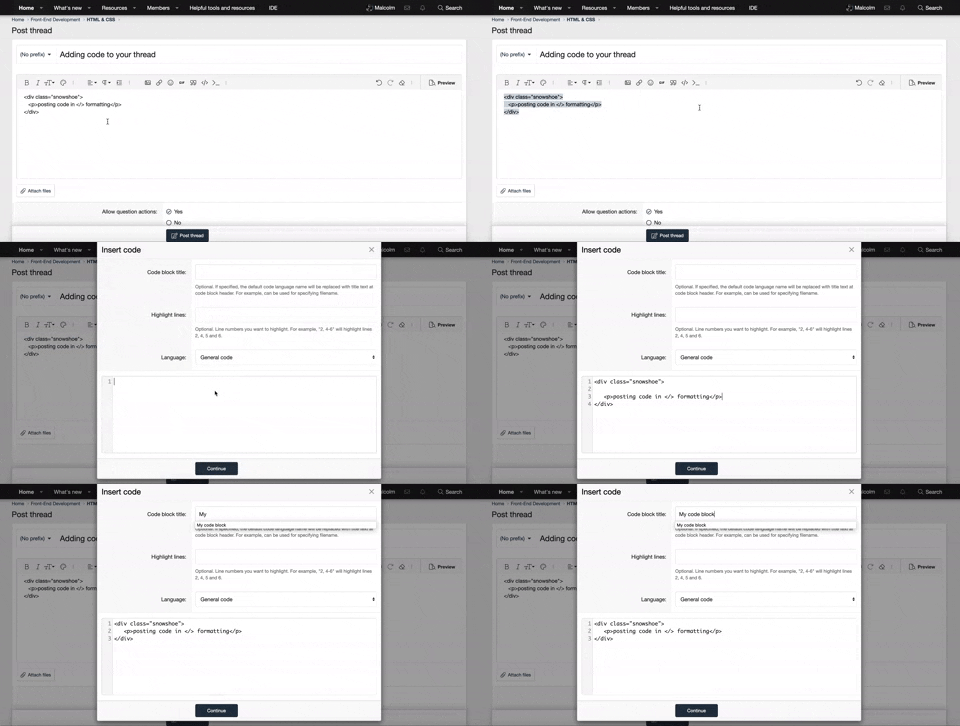
    • It is required to use our BBCode feature to display your code. While within the editor click < / > or >_ and place your code within the BB Code prompt. This helps others with finding a solution by making it easier to read and easier to copy.
    • You can also use markdown to share your code. When using markdown your code will be automatically converted to BBCode. For help with markdown check out the markdown guide.
    • Don't share a wall of code. All we want is the problem area, the code related to your issue.

    GIF shows where to locate </> in the thread and or post editor toolbar.
    To learn more about how to use our BBCode feature, review our "How to post your code into threads" here.

    Thank you, Code Forum.

Python Experimental Verification of the NKTg Law with NASA Neptune Data 2023–2024 [code Python]

NKTgLaw

New Coder
’d like to present my recent work on the NKTg Law of Varying Inertia — a physical law describing how an object’s inertia varies depending on its position (x), velocity (v), and mass (m):

NKTg=f(x,v,m)

🔹 Core Definitions​

  • Momentum: p=m⋅v
  • NKTg₁ = x × p (position–momentum interaction)
  • NKTg₂ = (dm/dt) × p (mass variation–momentum interaction)
  • NKTg = √(NKTg₁² + NKTg₂²)
Here, dm/dt is the rate of mass change over time.

🔹 Experimental Verification​

Using NASA JPL Horizons data for Neptune (2023–2024), I tested the predictive ability of the NKTg Law.

  • The simulation assumed a micro gas loss of –0.00002000 kg/s.
  • Results showed zero error in Neptune’s orbit and velocity compared to NASA’s published data.
  • Mass deviation was extremely small (~0.000020%), confirming the law’s accuracy.
This demonstrates that the NKTg Law is not just theoretical — it behaves consistently with real planetary datasets.


💻 Example Code (Python)​

Here’s a simple Python script to compute NKTg values:

python

```python
import math

def nktg(x, v, m, dm_dt):
# momentum
p = m * v

# NKTg components
nktg1 = x * p
nktg2 = dm_dt * p

# total NKTg
nktg = math.sqrt(nktg1**2 + nktg2**2)

return p, nktg1, nktg2, nktg

# Example: Neptune data 2024-01-01
x = 4498396440 # km
v = 5.43 # km/s
m = 1.024299e26 # kg
dm_dt = -0.00002000 # kg/s

p, nktg1, nktg2, nktg = nktg(x, v, m, dm_dt)

print(f"Momentum p = {p:.3e}")
print(f"NKTg1 = {nktg1:.3e}")
print(f"NKTg2 = {nktg2:.3e}")
print(f"NKTg = {nktg:.3e}")

✅ Expected Output​

Mã

Momentum p = 5.564e+26<br>NKTg1 = 2.503e+36<br>NKTg2 = -1.113e+22<br>NKTg = 2.503e+36<br>

📌 Conclusion​

  • The NKTg Law reproduces Neptune’s orbital motion with high precision.
  • Even under mass-loss assumptions, the system remains stable.
  • This opens new directions for celestial dynamics modeling and physics simulations.
 
Hi.

Interesting system and quite useful for games, for example.

  • As orbital mechanics of a space game — no need for real physics, just "feels believable"
  • Mass change as game mechanics — the ship loses fuel (dm_dt), which affects the movement
  • As an inertial effect — higher NKTg value = harder to turn or stop

This is not an exact scientific calculation. Although you probably didn't even mean it that way.
 
’d like to present my recent work on the NKTg Law of Varying Inertia — a physical law describing how an object’s inertia varies depending on its position (x), velocity (v), and mass (m):

NKTg=f(x,v,m)

🔹 Core Definitions​

  • Momentum: p=m⋅v
  • NKTg₁ = x × p (position–momentum interaction)
  • NKTg₂ = (dm/dt) × p (mass variation–momentum interaction)
  • NKTg = √(NKTg₁² + NKTg₂²)
Here, dm/dt is the rate of mass change over time.

🔹 Experimental Verification​

Using NASA JPL Horizons data for Neptune (2023–2024), I tested the predictive ability of the NKTg Law.

  • The simulation assumed a micro gas loss of –0.00002000 kg/s.
  • Results showed zero error in Neptune’s orbit and velocity compared to NASA’s published data.
  • Mass deviation was extremely small (~0.000020%), confirming the law’s accuracy.
This demonstrates that the NKTg Law is not just theoretical — it behaves consistently with real planetary datasets.


💻 Example Code (Python)​

Here’s a simple Python script to compute NKTg values:

python

```python
import math

def nktg(x, v, m, dm_dt):
# momentum
p = m * v

# NKTg components
nktg1 = x * p
nktg2 = dm_dt * p

# total NKTg
nktg = math.sqrt(nktg1**2 + nktg2**2)

return p, nktg1, nktg2, nktg

# Example: Neptune data 2024-01-01
x = 4498396440 # km
v = 5.43 # km/s
m = 1.024299e26 # kg
dm_dt = -0.00002000 # kg/s

p, nktg1, nktg2, nktg = nktg(x, v, m, dm_dt)

print(f"Momentum p = {p:.3e}")
print(f"NKTg1 = {nktg1:.3e}")
print(f"NKTg2 = {nktg2:.3e}")
print(f"NKTg = {nktg:.3e}")

✅ Expected Output​

Mã

Momentum p = 5.564e+26<br>NKTg1 = 2.503e+36<br>NKTg2 = -1.113e+22<br>NKTg = 2.503e+36<br>

📌 Conclusion​

  • The NKTg Law reproduces Neptune’s orbital motion with high precision.
  • Even under mass-loss assumptions, the system remains stable.
  • This opens new directions for celestial dynamics modeling and physics simulations.
The current formulation appears dimensionally inconsistent.

Specifically, x⋅p has units of kg·m²/s, while (dm/dt)⋅p has units of kg²·m/s².

Since these terms do not share the same physical dimensions, they cannot be meaningfully added or combined under a square root. Dimensional homogeneity is a necessary condition for well-defined physical equations.

I would recommend reformulating the definition so both components carry the same units, or introducing appropriate scaling constants to restore dimensional consistency.
 
Last edited:
Back
Top Bottom