woodturner550
Coder
First thing we must do is make sure everyone is using the same definitions. Deductive Logic is used. Distinguishing correct reasoning from incorrect reasoning is the task of logic.
Define: Unknowable, not able to be known. Lying beyond the limits of human experience or understanding, unknowability.
If the argument is that the variable being used is knowable, the following is the rebuttal.
When you use a stopwatch to time an event for example. You push the button to start the 'event', you cannot know the exact nanosecond that the event started. All you know is that you marked the beginning of the event. Even on a computer you can't know the exact nanosecond an event started because time moves only one direction. One cannot measure something that has not happened yet. If this is true, then good so far.
If not, it is your turn to explain exactly how it is knowable.
Define: Determinate, having exact and discernible limits or form, conclusively determined : DEFINITIVE.
There is no question digital computers are determinate as understood today. A poor example of a Determinate System: A pail of white paint. As long as only white paint is put into the pail and only white paint taken out it can represent a Determinate System. If this is understood as true, then good so far.
Define: Indeterminate, not exactly known, established, or defined. Not definitely or precisely determined or fixed, vague. Not known in advance. Not leading to a definite end or result. MATHEMATICS: (of a quantity) having no definite or definable value, conclusively indetermined.
Using the determinate white paint example. We can make it indeterminate by adding a colored paint. Now the unwhite paint is not a deterministic system any more.
I want the best random numbers I can get. I'm looking at what defines a random number set. There is no definitive standard for random numbers according to NIST. I think that "Best Possible Mean minus Standard Deviation" may be the way to get great random numbers.
Define “Best Possible Mean: Is the same as Mean, add all numbers in list and divide by number of items. I write it this way so it is understood that the best it can be is “Best Possible Mean”. Working with binary the “Best Possible Mean” is:
0 + 1 = (1 / 2) = 0.5.
Define Standard Deviation: A standard deviation (or σ) is a measure of how dispersed the data is in relation to the mean. Low, or small, standard deviation indicates data are clustered tightly around the mean, and high, or large, standard deviation indicates data are more spread out.
The closer to “Best Possible Mean” and random is what the goal is. Therefore “Best Possible Mean” minus Standard Deviation is a concrete base for random. It gives a definitive way of working with random numbers.
I'm looking at what makes a random number random, as well as how to qualify random numbers.
I'm looking for the best base to work from. I challenge everything. I believe that digital computers CAN make "real" random numbers. I know digital computers are deterministic as understood today. If you add an unknowable properly the Deterministic System becomes an Indeterminate System.
What does “unknowable” mean? The future is unknowable because the future is dependent on everything that has happen before. Unless you can “know” the future, you cannot know an “unknowable”.
Deterministic System is a system in which no randomness is involved in the development of future states of the system.
Fact: All digital computers run by deterministic programs! However, when you add an unknowable the Deterministic System becomes indeterminate. Poor Example: You have a bucket of white paint to represent a Deterministic System. As long as you only take white paint out or put white paint in it’s deterministic, you will get white paint. Now when you throw a little unknown colored paint into the mix what do you get but an Indeterminate System.
When you use a stopwatch to time an event for example. You push the button to start the 'event', you cannot know the exact nanosecond that the event started. All you know is that you marked the beginning of the event. Even on a computer you can't know the exact nanosecond an event started. If this is true, then good so far.
This 'time' at the start of an event is what we want for the 'seed' for random numbers. It's how 'time' is used to make the seed that is important. Using 'time' alone does not work at all. I've found out how to use 'time' Nanosecond time to make perfect 'seeds'.
As far as I know this is the best definition of "Random".
1. It looks random. This means that it passes all the statistical tests of randomness that we can find.
2. It is unpredictable. It must be computationally infeasible to predict what the next random bit will be, given complete knowledge of the algorithm or hardware generating the sequence and all of the previous bits in the stream.
3. It cannot be reliably reproduced. If you run the sequence generator twice with the exact same input (at least as exact as humanly possible), you will get two completely unrelated random sequences.
The output of a generator satisfying these three properties will be good enough for a one-time pad, key generation, and any other cryptographic applications that require a truly random sequence generator.
The following data is from my twenty-two line “real random number generator” program in Python 3.7.
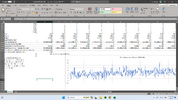
This is the Standard Deviation of 400 sets of 10,000 random binary bits (0,1) broken into four equal parts. Each part comprises of 100 sets of 10,000 random bit, 1,000,000 bits total. The four groups together is 4,000,000 bits. The best that can be achieved is 0.5., and that is not random, it is in order.
0.499993153 - 0.5 = -0.000007
0.500000244 – 0.5 = 0.00000002.44
0.499995232 – 0.5 = -0.000005
0.4999945 – 0.5 = -0.000006
I always give data from a data set so it can be verified if needed. There is going to be a very small remainder because it IS random (example_0.00000). Doesn’t get any better than this.
This knowledge will affect: Number Theory; Linear and Multilinear Algebra; Potential Theory; Statistics; Numerical Analysis; Statistical Mechanics, Structure of Matter.
The following is Copyrighted: Copyrighted owner data is public data.
#80462747
Python 3.7 - By: Leonard Dye, P.O.Box 1456, Waldport, Or. 97394, [email protected]
_________________________________________________________
As soon as it is recognized as correct, then I can explain what and how this program came into being. There is a lot of great research to be done now. I just opened the door to a place to investigate. Random numbers are very interesting. This advancement will make digital computers much more powerful.
I am hoping my work will inspire others to explore and challenge everything. Must follow the laws of nature and logic. A word about ‘logic’. It is the one thing that I use that is not taught in schools. It is as important as understanding the laws of nature or physics.
Any thoughts are welcome. The facts will stand up to the ‘hard look’ by anyone. There is more that I have learned but cannot be understood till ‘real random numbers’ CAN be made by digital computers is understood as fact.
Think what can be done with everybody being able to have real random numbers. Encryption on the fly. Data stored encrypted, no more ransom for data. All they would have is encrypted files that they cannot read. This is just one gain from this.
All constructive comments are welcomed. Questions are great.
Define: Unknowable, not able to be known. Lying beyond the limits of human experience or understanding, unknowability.
If the argument is that the variable being used is knowable, the following is the rebuttal.
When you use a stopwatch to time an event for example. You push the button to start the 'event', you cannot know the exact nanosecond that the event started. All you know is that you marked the beginning of the event. Even on a computer you can't know the exact nanosecond an event started because time moves only one direction. One cannot measure something that has not happened yet. If this is true, then good so far.
If not, it is your turn to explain exactly how it is knowable.
Define: Determinate, having exact and discernible limits or form, conclusively determined : DEFINITIVE.
There is no question digital computers are determinate as understood today. A poor example of a Determinate System: A pail of white paint. As long as only white paint is put into the pail and only white paint taken out it can represent a Determinate System. If this is understood as true, then good so far.
Define: Indeterminate, not exactly known, established, or defined. Not definitely or precisely determined or fixed, vague. Not known in advance. Not leading to a definite end or result. MATHEMATICS: (of a quantity) having no definite or definable value, conclusively indetermined.
Using the determinate white paint example. We can make it indeterminate by adding a colored paint. Now the unwhite paint is not a deterministic system any more.
I want the best random numbers I can get. I'm looking at what defines a random number set. There is no definitive standard for random numbers according to NIST. I think that "Best Possible Mean minus Standard Deviation" may be the way to get great random numbers.
Define “Best Possible Mean: Is the same as Mean, add all numbers in list and divide by number of items. I write it this way so it is understood that the best it can be is “Best Possible Mean”. Working with binary the “Best Possible Mean” is:
0 + 1 = (1 / 2) = 0.5.
Define Standard Deviation: A standard deviation (or σ) is a measure of how dispersed the data is in relation to the mean. Low, or small, standard deviation indicates data are clustered tightly around the mean, and high, or large, standard deviation indicates data are more spread out.
The closer to “Best Possible Mean” and random is what the goal is. Therefore “Best Possible Mean” minus Standard Deviation is a concrete base for random. It gives a definitive way of working with random numbers.
I'm looking at what makes a random number random, as well as how to qualify random numbers.
I'm looking for the best base to work from. I challenge everything. I believe that digital computers CAN make "real" random numbers. I know digital computers are deterministic as understood today. If you add an unknowable properly the Deterministic System becomes an Indeterminate System.
What does “unknowable” mean? The future is unknowable because the future is dependent on everything that has happen before. Unless you can “know” the future, you cannot know an “unknowable”.
Deterministic System is a system in which no randomness is involved in the development of future states of the system.
Fact: All digital computers run by deterministic programs! However, when you add an unknowable the Deterministic System becomes indeterminate. Poor Example: You have a bucket of white paint to represent a Deterministic System. As long as you only take white paint out or put white paint in it’s deterministic, you will get white paint. Now when you throw a little unknown colored paint into the mix what do you get but an Indeterminate System.
When you use a stopwatch to time an event for example. You push the button to start the 'event', you cannot know the exact nanosecond that the event started. All you know is that you marked the beginning of the event. Even on a computer you can't know the exact nanosecond an event started. If this is true, then good so far.
This 'time' at the start of an event is what we want for the 'seed' for random numbers. It's how 'time' is used to make the seed that is important. Using 'time' alone does not work at all. I've found out how to use 'time' Nanosecond time to make perfect 'seeds'.
As far as I know this is the best definition of "Random".
1. It looks random. This means that it passes all the statistical tests of randomness that we can find.
2. It is unpredictable. It must be computationally infeasible to predict what the next random bit will be, given complete knowledge of the algorithm or hardware generating the sequence and all of the previous bits in the stream.
3. It cannot be reliably reproduced. If you run the sequence generator twice with the exact same input (at least as exact as humanly possible), you will get two completely unrelated random sequences.
The output of a generator satisfying these three properties will be good enough for a one-time pad, key generation, and any other cryptographic applications that require a truly random sequence generator.
The following data is from my twenty-two line “real random number generator” program in Python 3.7.
This is the Standard Deviation of 400 sets of 10,000 random binary bits (0,1) broken into four equal parts. Each part comprises of 100 sets of 10,000 random bit, 1,000,000 bits total. The four groups together is 4,000,000 bits. The best that can be achieved is 0.5., and that is not random, it is in order.
0.499993153 - 0.5 = -0.000007
0.500000244 – 0.5 = 0.00000002.44
0.499995232 – 0.5 = -0.000005
0.4999945 – 0.5 = -0.000006
I always give data from a data set so it can be verified if needed. There is going to be a very small remainder because it IS random (example_0.00000). Doesn’t get any better than this.
This knowledge will affect: Number Theory; Linear and Multilinear Algebra; Potential Theory; Statistics; Numerical Analysis; Statistical Mechanics, Structure of Matter.
The following is Copyrighted: Copyrighted owner data is public data.
#80462747
Python 3.7 - By: Leonard Dye, P.O.Box 1456, Waldport, Or. 97394, [email protected]
Real Random Number Generator
Code:
import time
import random

number_of_needed_numbers = 10000
lower_value = 0
upper_value = 1
count = 0
short_time = 0.00000000000001
OFFSET_TIME = 0.03258312993051001


while count < number_of_needed_numbers:
     start_time = time.time()
     start_time2 = start_time - OFFSET_TIME
     time.sleep(short_time)
     end_time = time.time()
     total_seed = end_time - start_time2
     random.seed(total_seed)
     random_number = random.randint(lower_value, upper_value)
     count = count + 1
print(random_number)As soon as it is recognized as correct, then I can explain what and how this program came into being. There is a lot of great research to be done now. I just opened the door to a place to investigate. Random numbers are very interesting. This advancement will make digital computers much more powerful.
I am hoping my work will inspire others to explore and challenge everything. Must follow the laws of nature and logic. A word about ‘logic’. It is the one thing that I use that is not taught in schools. It is as important as understanding the laws of nature or physics.
Any thoughts are welcome. The facts will stand up to the ‘hard look’ by anyone. There is more that I have learned but cannot be understood till ‘real random numbers’ CAN be made by digital computers is understood as fact.
Think what can be done with everybody being able to have real random numbers. Encryption on the fly. Data stored encrypted, no more ransom for data. All they would have is encrypted files that they cannot read. This is just one gain from this.
All constructive comments are welcomed. Questions are great.