ratwolf
Bronze Coder
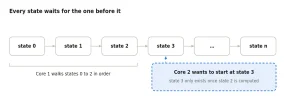
Parallelizing strictly sequential, deterministic chaotic loops usually fails due to two constraints: strict serial dependence (point \(N\) requires \(N-1\)) and memory explosion when storing billions of coordinates for density mapping.
To solve this, I developed a pattern called Two-Pass Checkpointed Orbit Decomposition and implemented it for both the Hopalong Map (area-preserving) and the Hénon–Heiles potential (using a synchronized Leapfrog/Verlet integrator).
The Architecture:



Mathematical Rigor:
Chaotic systems amplify the tiniest rounding errors. By avoiding fastmath and using hardware-supported Fused Multiply-Add (fma) intrinsics, the parallel multi-threaded output is pixel-for-pixel bit-identical to a plain, single-core serial loop.
Code:
Both implementations are clean, single-file Python/Numba scripts
To solve this, I developed a pattern called Two-Pass Checkpointed Orbit Decomposition and implemented it for both the Hopalong Map (area-preserving) and the Hénon–Heiles potential (using a synchronized Leapfrog/Verlet integrator).
The Architecture:
- Pass 1 (Serial Pre-computation): A single thread walks the orbit to find exact spatial boundaries and drops lightweight checkpoints (4 floats for the full state) at segment intervals.
- Pass 2 (Parallel Multi-Lane Replay): Worker threads ingest checkpoints via Numba’s prange. Each worker advances 4 independent segments side-by-side (lanes) in lock-step to fill CPU pipelines during dependent floating-point operations.
- Flat Memory: Points are immediately binned into private pixel-grid histograms and discarded. Memory usage remains constant regardless of the total point count.
Mathematical Rigor:
Chaotic systems amplify the tiniest rounding errors. By avoiding fastmath and using hardware-supported Fused Multiply-Add (fma) intrinsics, the parallel multi-threaded output is pixel-for-pixel bit-identical to a plain, single-core serial loop.
Code:
Both implementations are clean, single-file Python/Numba scripts
Last edited: