
ratwolf
Bronze Coder
The Game of Nim and the mathematical background of how to win the game
GitHub
GitHub
Python:
import numpy as np
import matplotlib.pyplot as plt
from matplotlib.widgets import Slider

# Constants
SAFE_COLOR = "seagreen"  # Green for safe positions
UNSAFE_COLOR = "tomato"  # Red for unsafe positions
DEFAULT_COLOR = "royalblue"  # Blue for heaps

INITIAL_HEAPS = [1, 3, 5, 7]  # Initial heap sizes
MAX_HEAP_SIZE = max(INITIAL_HEAPS)  # Maximum heap size for sliders

# UI Layout Constants
FIG_SIZE_HEAP = (8, 8)  # Figure size for heap visualization
FIG_SIZE_TABLE = (8, 6)  # Figure size for the information table
BOTTOM_ADJUST = 0.1  # Space at the bottom for UI elements
HEAP_SPACING = 2  # Horizontal spacing between heap positions
CIRCLE_RADIUS = 0.4  # Radius of heap circles
NIM_SUM_MIN_BITS = 4  # Ensure at least 4-bit binary representation

# Slider Layout Constants
SLIDER_WIDTH = 0.6
SLIDER_HEIGHT = 0.03
SLIDER_START_X = 0.2
SLIDER_START_Y = 0.08
SLIDER_SPACING = 0.05  # Vertical space between sliders

# Table Layout Constants
TABLE_BBOX = [0, 0.5, 1, 0.5]  # Position of the table
TABLE_FONT_SIZE = 10
COLUMN_WIDTHS = [0.1, 0.1, 0.15, 0.05, 0.15, 0.05, 0.15, 0.1, 0.15]  # Column width ratios

class NimGame:
    def __init__(self, heaps):
        self.heaps = heaps
        self.nim_val = 0
        self.binary_heaps = []
        self.binary_nim_val = ""
        self.xor_equation = ""
        self.heaps_changed = True  # Flag to track if heaps have changed

        self.fig, self.ax = plt.subplots(figsize=FIG_SIZE_HEAP)
        self.fig_info, self.ax_info = plt.subplots(figsize=FIG_SIZE_TABLE)
        self.fig.canvas.manager.set_window_title("🔵 Heap Visualization 🔵")
        self.fig_info.canvas.manager.set_window_title("🧮 Mathematical Insights 🧮")
        self.sliders = []

        self.setup_ui()

    def compute_nim_sum(self):
        """Compute the nim-sum and store it to avoid redundant calculations."""
        if self.heaps_changed:
            max_bits = max(NIM_SUM_MIN_BITS, max(self.heaps).bit_length())
            self.binary_heaps = [bin(h)[2:].zfill(max_bits) for h in self.heaps]
            self.nim_val = np.bitwise_xor.reduce(self.heaps)
            self.binary_nim_val = bin(self.nim_val)[2:].zfill(max_bits)
            self.xor_equation = " ⊕ ".join(self.binary_heaps) + f" = {self.binary_nim_val}"
            self.heaps_changed = False

    def setup_ui(self):
        """Set up the UI, including sliders and initial plot."""
        plt.subplots_adjust(bottom=BOTTOM_ADJUST)
        self.ax_info.axis("off")
        self.plot_nim()
        self.create_sliders()

    def setup_axes(self):
        """Set up axes properties for the heap plot."""
        self.ax.clear()
        self.ax.set_xlim(-1, len(self.heaps) * HEAP_SPACING)
        self.ax.set_ylim(-0.5, MAX_HEAP_SIZE)
        self.ax.set_xticks(range(0, len(self.heaps) * HEAP_SPACING, HEAP_SPACING))
        self.ax.set_xticklabels([f"Heap {i+1}" for i in range(len(self.heaps))])
        self.ax.set_yticks([])
        self.ax.set_facecolor('#F5F5F5')
        self.ax.set_aspect('auto')

    def generate_table_data(self):
        """Generate data for the table using stored Nim-sum values."""
        xor_results = [h ^ self.nim_val for h in self.heaps]

        table_data = [
            [
                f"Heap {i+1}",
                h,
                self.binary_heaps[i],
                "⊕",
                self.binary_nim_val,
                "=",
                bin(xor_results[i])[2:].zfill(len(self.binary_nim_val)),
                xor_results[i],
                "YES" if xor_results[i] < h else "NO"
            ]
            for i, h in enumerate(self.heaps)
        ]

        # Add the Nim-sum row at the bottom
        table_data.append([
            "Nim-Sum *", self.nim_val, self.binary_nim_val, "", "", "", "", "", ""
        ])

        return table_data

    def draw_heap_circles(self):
        """Draw circles representing the heaps."""
        for i, h in enumerate(self.heaps):
            for j in range(h):
                self.ax.add_patch(plt.Circle((i * HEAP_SPACING, j), CIRCLE_RADIUS, color=DEFAULT_COLOR))

    def update_table(self):
        """Update the table using stored Nim-sum values."""
        self.ax_info.clear()
        self.ax_info.axis("off")

        table_data = self.generate_table_data()
        column_labels = ["Heap#", "Dec", "Bin", "", "Nim-Sum", "", "Bin'", "Dec'", "Safe Move?"]

        # Create and format table
        table = self.ax_info.table(cellText=table_data, colLabels=column_labels, cellLoc="center", loc="center", bbox=TABLE_BBOX)
        table.auto_set_font_size(False)
        table.set_fontsize(TABLE_FONT_SIZE)

        # Adjust column widths
        for i, width in enumerate(COLUMN_WIDTHS):
            table.auto_set_column_width(i)
            table.get_celld()[(0, i)].set_width(width)

        # Make header labels bold
        for (row, col), cell in table.get_celld().items():
            if row == 0:  # Header row
                cell.get_text().set_weight("bold")

        # Change cell colors for "Safe Move?"
        for row in range(1, len(table_data)):
            cell = table.get_celld()[(row, 8)]
            cell.set_facecolor(SAFE_COLOR if table_data[row-1][8] == "YES" else UNSAFE_COLOR)

        # Change cell color and weight for "Dec'" column based on "Safe Move?"
        for row in range(1, len(table_data)):
            safe_move = table_data[row-1][8] == "YES"
            color = SAFE_COLOR if safe_move else UNSAFE_COLOR
            cell = table.get_celld()[(row, 7)]
            cell.get_text().set_weight("bold")
            cell.get_text().set_color(color)

        # Make the Nim-sum row bold
        for col in range(len(column_labels)):
            cell = table.get_celld()[(len(table_data), col)]
            cell.get_text().set_weight("bold")

        # Display XOR equation below the table
        self.ax_info.text(0.5, 0.44, f"*Nim-Sum = Bitwise XOR of All Heap Sizes: {self.xor_equation}",
                          fontsize=10, ha="center", weight="normal", family="monospace")

        # Explanation of XOR (⊕) symbol
        self.ax_info.text(0.5, 0.35, "Note: ⊕ represents the bitwise XOR operation, which compares binary digits \n"
                                     "and returns 1 if they are different and 0 if they are the same.",
                          fontsize=9, ha="center", weight="normal", family="monospace")

    def plot_nim(self):
        """Update the entire UI without redundant Nim-sum calculations."""
        self.compute_nim_sum()  # Recalculate only when needed
        self.setup_axes()
        self.ax.set_title(f"Nim-Sum = {self.nim_val} ({self.binary_nim_val}) ({'Safe' if self.nim_val == 0 else 'Unsafe'})",
                          fontsize=14, color=SAFE_COLOR if self.nim_val == 0 else UNSAFE_COLOR)

        self.draw_heap_circles()
        self.update_table()
        self.fig.canvas.draw_idle()
        self.fig_info.canvas.draw_idle()

    def create_sliders(self):
        """Create sliders for heap size adjustment."""
        for i in range(len(self.heaps)):
            ax_slider = plt.axes([SLIDER_START_X, SLIDER_START_Y + (len(self.heaps) - i - 1) * SLIDER_SPACING, SLIDER_WIDTH, SLIDER_HEIGHT])
            slider = Slider(ax_slider, f"Heap {i+1}", 0, MAX_HEAP_SIZE, valinit=self.heaps[i], valstep=1)
            slider.on_changed(self.update)
            self.sliders.append(slider)

    def update(self, val):
        """Callback for slider updates."""
        self.heaps = [int(slider.val) for slider in self.sliders]
        self.heaps_changed = True  # Set flag to indicate heaps have changed
        self.plot_nim()

# Initialize and run the Nim game
if __name__ == "__main__":
    nim_game = NimGame(INITIAL_HEAPS)
    plt.show(block=True)
Markdown (GitHub flavored):
# The Game of Nim: A Tutorial

The Game of Nim is a mathematical strategy game where two players take turns removing objects from heaps or piles. The goal is to be the player who takes the last object. Although it may appear complex at first, Nim has a simple yet beautiful winning strategy based on binary arithmetic and the concept of the "Nim-sum."

## How to Play

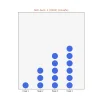
1. **Setup:** The game starts with several heaps, each containing a specific number of objects (e.g., sticks, stones, coins). You can adjust the number of objects in each heap using the sliders in our interactive visualization. The default setup includes four heaps.

2. **Turns:** Players alternate turns. On each turn, a player *must* select a heap and remove at least one object from it. A player can remove any number of objects from the chosen heap, up to the entire heap.

3. **Winning:** The player who takes the last object wins the game.

---

## The Secret: Binary XOR and the Nim-sum

The key to winning Nim lies in understanding the Nim-sum, calculated using the bitwise XOR operation (`^` or "XOR").

1. **Binary Representation:** Convert the number of objects in each heap to binary. For example, 5 in decimal is `101` in binary. The code uses a 4-bit binary representation, so 5 becomes `0101`.

2. **Bitwise XOR:** The XOR operation compares the bits in the binary representations of heap sizes. If the bits are the same (0 and 0 or 1 and 1), the result is 0. If the bits are different (0 and 1 or 1 and 0), the result is 1. We perform this operation on the binary representations of *all* heap sizes.

---

## Calculating the Nim-sum: An Example

Let’s consider heaps with sizes 1, 3, 5, and 7:

    1 (decimal) = 0001 (binary)
    3 (decimal) = 0011 (binary)
    5 (decimal) = 0101 (binary)
    7 (decimal) = 0111 (binary)

The Nim-sum is the result of XORing all heap sizes:

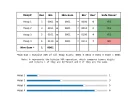
    Nim-sum = 0001 XOR 0011 XOR 0101 XOR 0111 = 0000 (binary) = 0 (decimal)

By comparing each bit, we get:

- **Rightmost bit:** 1 XOR 1 XOR 1 XOR 1 = 0
- **Second bit from right:** 0 XOR 1 XOR 0 XOR 1 = 0
- **Third bit from right:** 0 XOR 0 XOR 1 XOR 1 = 0
- **Leftmost bit:** 0 XOR 0 XOR 0 XOR 0 = 0

Thus, the Nim-sum is `0000` (0 in decimal).

---

## Winning Strategy

### Unsafe Positions (Nim-sum ≠ 0)

A position where the Nim-sum is not zero is considered an unsafe position. The player whose turn it is can always make a move that results in the Nim-sum becoming zero.

### Safe Positions (Nim-sum = 0)

A position where the Nim-sum is zero is a safe position. If you find yourself in this position, your opponent will always be forced to leave the Nim-sum non-zero, giving you the opportunity to make it zero again.

---

### **How to Win**

**Calculate the Nim-sum:**
Before your turn, compute the Nim-sum of the current heap sizes. The Nim-sum is the bitwise XOR of all heap sizes:

$$
\large
Nim-sum = h₁ ⊕ h₂ ⊕ ... ⊕ hₙ
\large
$$

**If the Nim-sum is 0:**
You are in a **safe position** (a losing position if your opponent plays optimally).
Any move you make will result in a nonzero Nim-sum, giving your opponent a winning strategy.

**If the Nim-sum is not 0:**
You are in an **unsafe position** (a winning position if you play optimally).
To move to a safe position, find a heap $$\large h_i \large$$ such that:

$$
\large
h_i > h_i ⊕ Nim-sum
\large
$$

Reduce $$h_i$$ to the new value:

$$
\large
h_i' = h_i ⊕ Nim-sum
\large
$$

This ensures that the new Nim-sum becomes 0, putting your opponent in a losing position
Last edited: