
ratwolf
Bronze Coder
Below a fixed example for a 3D sphere
Challenge:
Design and implement an algorithm that takes as input a smooth, parametrically defined 3D surface described by analytic formulas. This algorithm should automatically determine a suitable projection center for stereographic projection and compute the corresponding 2D projection. The algorithm should then reconstruct the original 3D surface from this 2D projection. The quality of the projection (projection center selection) and the accuracy of the reconstruction will be evaluated by comparing the original surface to the reconstructed surface. The algorithm should be computationally efficient, leveraging the analytic formulas defining the 3D surface.😱
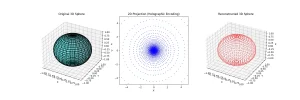
Description:
How Stereographic Projection Can Demonstrate an Emergent Dimension?
The stereographic projection provides a classical analogy for the concept of emergent dimensions, showing how higher-dimensional information can be encoded onto a lower-dimensional surface. This can be used to explore the idea that the third dimension of spacetime might not be fundamental, but rather an emergent property arising from a more fundamental 2D description.
However, it's important to note that the real holographic principle in quantum mechanics is a bit more complicated. It involves quantum entanglement and boundary field theories in ways that go beyond the simple classical analogy provided by stereographic projection.
Challenge:
Design and implement an algorithm that takes as input a smooth, parametrically defined 3D surface described by analytic formulas. This algorithm should automatically determine a suitable projection center for stereographic projection and compute the corresponding 2D projection. The algorithm should then reconstruct the original 3D surface from this 2D projection. The quality of the projection (projection center selection) and the accuracy of the reconstruction will be evaluated by comparing the original surface to the reconstructed surface. The algorithm should be computationally efficient, leveraging the analytic formulas defining the 3D surface.😱
Python:
import numpy as np
import matplotlib.pyplot as plt
from mpl_toolkits.mplot3d import Axes3D

def parametric_surface(u, v, shape):
    """
    Generate parametric surface based on user selection.
    """
    if shape == "sphere":
        x = np.sin(u) * np.cos(v)
        y = np.sin(u) * np.sin(v)
        z = np.cos(u)
    elif shape == "cone":
        k = 1  # Cone slope
        r = u
        x = r * np.cos(v)
        y = r * np.sin(v)
        z = k * r
    elif shape == "paraboloid":
        r = u
        x = r * np.cos(v)
        y = r * np.sin(v)
        z = r ** 2  # Parabolic height
    else:
        raise ValueError("Unknown shape: Choose 'sphere', 'cone', 'paraboloid'")
    return x, y, z

def stereographic_projection(x, y, z):
    """
    Apply stereographic projection from the north pole (z = 1).
    """
    with np.errstate(divide='ignore', invalid='ignore'):
        x_proj = x / (1 - z)
        y_proj = y / (1 - z)
    return x_proj, y_proj

def inverse_projection(x_proj, y_proj, shape):
    """
    Reconstruct 3D surface based on original shape equation.
    """
    r_proj = np.sqrt(x_proj**2 + y_proj**2)
    phi_proj = np.arctan2(y_proj, x_proj)

    if shape == "sphere":
        denom = 1 + r_proj**2
        x_recon = (2 * x_proj) / denom
        y_recon = (2 * y_proj) / denom
        z_recon = (1 - r_proj**2) / denom
    elif shape == "cone":
        x_recon = x_proj
        y_recon = y_proj
        z_recon = np.sqrt(x_proj**2 + y_proj**2)  # Matching cone equation
    elif shape == "paraboloid":
        x_recon = x_proj
        y_recon = y_proj
        z_recon = x_proj**2 + y_proj**2  # Matching paraboloid equation

    else:
        raise ValueError("Unknown shape: Choose 'sphere', 'cone', 'paraboloid', or 'ellipsoid'.")

    return x_recon, y_recon, z_recon

# Select shape
shape_type = "cone"  # Change this to test different shapes

# Generate a parametric surface
u_res, v_res = 50, 100  # Increased resolution
u = np.linspace(0, np.pi, u_res) if shape_type == "sphere" else np.linspace(0, 1, u_res)
v = np.linspace(0, 2 * np.pi, v_res)
u, v = np.meshgrid(u, v)

x, y, z = parametric_surface(u, v, shape_type)

# Apply stereographic projection
x_proj, y_proj = stereographic_projection(x, y, z)

# Reconstruct the surface using inverse projection
x_recon, y_recon, z_recon = inverse_projection(x_proj, y_proj, shape_type)

# Explicitly close the grid by appending the first row to the end
x_recon = np.vstack([x_recon, x_recon[0, :]])
y_recon = np.vstack([y_recon, y_recon[0, :]])
z_recon = np.vstack([z_recon, z_recon[0, :]])

# Create figure with 3 subplots
fig = plt.figure(figsize=(18, 6))

# --- Original 3D Surface ---
ax1 = fig.add_subplot(131, projection='3d')
ax1.plot_surface(x, y, z, color='cyan', edgecolor='black', alpha=0.3)
ax1.set_title(f"Original 3D {shape_type.capitalize()}")
ax1.set_xlabel("X")
ax1.set_ylabel("Y")
ax1.set_zlabel("Z")

# --- 2D Projection ---
ax2 = fig.add_subplot(132)
ax2.scatter(x_proj, y_proj, s=1, color='blue')
ax2.set_title("2D Projection (Holographic Encoding)")
ax2.set_xlabel("X'")
ax2.set_ylabel("Y'")
ax2.set_xlim([-5, 5])
ax2.set_ylim([-5, 5])
ax2.set_aspect('equal')

# --- Reconstructed 3D Surface ---
ax3 = fig.add_subplot(133, projection='3d')

# Choose between coarse surface grid or wireframe
visualization_mode = "coarse_grid"  # Change to "coarse_grid" for coarse surface grid

if visualization_mode == "coarse_grid":
    # Coarse surface grid
    ax3.plot_surface(x_recon, y_recon, z_recon, color='red', edgecolor='black', alpha=0.3, rstride=5, cstride=5)
elif visualization_mode == "wireframe":
    # Wireframe
    ax3.plot_wireframe(x_recon, y_recon, z_recon, color='red', rstride=5, cstride=5)
else:
    raise ValueError("Unknown visualization mode: Choose 'coarse_grid' or 'wireframe'")

ax3.set_title(f"Reconstructed 3D {shape_type.capitalize()}")
ax3.set_xlabel("X")
ax3.set_ylabel("Y")
ax3.set_zlabel("Z")

plt.show()
Description:
How Stereographic Projection Can Demonstrate an Emergent Dimension?
The stereographic projection provides a classical analogy for the concept of emergent dimensions, showing how higher-dimensional information can be encoded onto a lower-dimensional surface. This can be used to explore the idea that the third dimension of spacetime might not be fundamental, but rather an emergent property arising from a more fundamental 2D description.
Stereographic Projection Overview
The stereographic projection maps points from a 3D sphere onto a 2D plane, offering a way to encode 3D information onto a 2D surface. This projection is reversible, meaning we can reconstruct the 3D sphere from the 2D projection.1. Stereographic Projection Formula
Given a unit sphere S² centered at the origin in 3D space with coordinates (x, y, z), the stereographic projection onto a plane (typically the xy-plane) is given by the following formulas:- x' = x / (1 - z)
- y' = y / (1 - z)
2. Inverse Stereographic Projection
To recover the 3D coordinates from the 2D projection, we use the inverse stereographic projection:- x = 2x' / (1 + x'² + y'²)
- y = 2y' / (1 + x'² + y'²)
- z = (1 - x'² - y'²) / (1 + x'² + y'²)
Demonstrating Emergence
In the context of the holographic principle, the stereographic projection serves as a metaphor for how a 3D system could be encoded in a lower-dimensional surface, much like how spacetime (including the third dimension) might emerge from a more fundamental 2D description. This supports the idea that dimensions are not necessarily fundamental but could arise as emergent properties from quantum field theories on a boundary.However, it's important to note that the real holographic principle in quantum mechanics is a bit more complicated. It involves quantum entanglement and boundary field theories in ways that go beyond the simple classical analogy provided by stereographic projection.
Conclusion
By examining the stereographic projection in this way, we see how information from higher dimensions (such as 3D) can be encoded in lower-dimensional surfaces (like 2D), offering a visual representation of how emergent dimensions might work in a quantum gravity framework.
HTML:
<!DOCTYPE html PUBLIC "-//W3C//DTD XHTML 1.0 Strict//EN"
    "http://www.w3.org/TR/xhtml1/DTD/xhtml1-strict.dtd">
<html xmlns="http://www.w3.org/1999/xhtml" xml:lang="en" lang="en">

<head>
    <!DOCTYPE html>
<html lang="en">
<head>
    <meta charset="UTF-8">
    <meta name="viewport" content="width=device-width, initial-scale=1.0">
    <title>How Stereographic Projection Can Demonstrate an Emergent Dimension?</title>
    <!-- Include MathJax for LaTeX rendering -->
    <script type="text/javascript" async
        src="https://cdnjs.cloudflare.com/ajax/libs/mathjax/2.7.7/MathJax.js?config=TeX-MML-AM_CHTML">
    </script>
</head>
<body>
    <h1>How Stereographic Projection Can Demonstrate an Emergent Dimension?</h1>

    <p>The <strong>stereographic projection</strong> provides a classical analogy for the concept of <strong>emergent dimensions</strong>, showing how higher-dimensional information can be encoded onto a lower-dimensional surface. This can be used to explore the idea that the <strong>third dimension</strong> of spacetime might not be fundamental, but rather an <strong>emergent property</strong> arising from a more fundamental 2D description.</p>

    <h2>Stereographic Projection Overview</h2>

    <p>The stereographic projection maps points from a <strong>3D sphere</strong> onto a <strong>2D plane</strong>, offering a way to encode 3D information onto a 2D surface. This projection is reversible, meaning we can reconstruct the 3D sphere from the 2D projection.</p>

    <h3>1. Stereographic Projection Formula</h3>

    <p>Given a unit sphere <em>S<sup>2</sup></em> centered at the origin in 3D space with coordinates <em>(x, y, z)</em>, the <strong>stereographic projection</strong> onto a plane (typically the <em>xy</em>-plane) is given by the following formulas:</p>

    <p>
        $$ x' = \frac{x}{1 - z}, \quad y' = \frac{y}{1 - z} $$
    </p>

    <p>where <em>(x', y')</em> are the coordinates of the point on the 2D plane.</p>

    <h3>2. Inverse Stereographic Projection</h3>

    <p>To recover the 3D coordinates from the 2D projection, we use the <strong>inverse stereographic projection</strong>:</p>

    <p>
        $$ x = \frac{2x'}{1 + x'^2 + y'^2}, \quad y = \frac{2y'}{1 + x'^2 + y'^2}, \quad z = \frac{1 - x'^2 - y'^2}{1 + x'^2 + y'^2} $$
    </p>

    <p>These formulas allow us to reconstruct the 3D sphere from its 2D projection, illustrating the idea that the <strong>third dimension</strong> might emerge from <strong>lower-dimensional data</strong>.</p>

    <h2>Demonstrating Emergence</h2>

    <p>In the context of the <strong>holographic principle</strong>, the stereographic projection serves as a metaphor for how a 3D system could be encoded in a lower-dimensional surface, much like how <strong>spacetime</strong> (including the third dimension) might emerge from a more fundamental 2D description. This supports the idea that dimensions are <strong>not necessarily fundamental</strong> but could arise as <strong>emergent properties</strong> from quantum field theories on a boundary.</p>

    <p>However, it's important to note that the <strong>real holographic principle</strong> in <strong>quantum mechanics</strong> is a bit more complicated. It involves <strong>quantum entanglement</strong> and <strong>boundary field theories</strong> in ways that go beyond the simple classical analogy provided by stereographic projection.</p>

    <h3>Conclusion</h3>

    <p>By examining the <strong>stereographic projection</strong> in this way, we see how <strong>information from higher dimensions</strong> (such as 3D) can be encoded in <strong>lower-dimensional surfaces</strong> (like 2D), offering a visual representation of how <strong>emergent dimensions</strong> might work in a quantum gravity framework.</p>
</body>
</html>

</head>

<body>

</body>

</html>
Last edited:




